


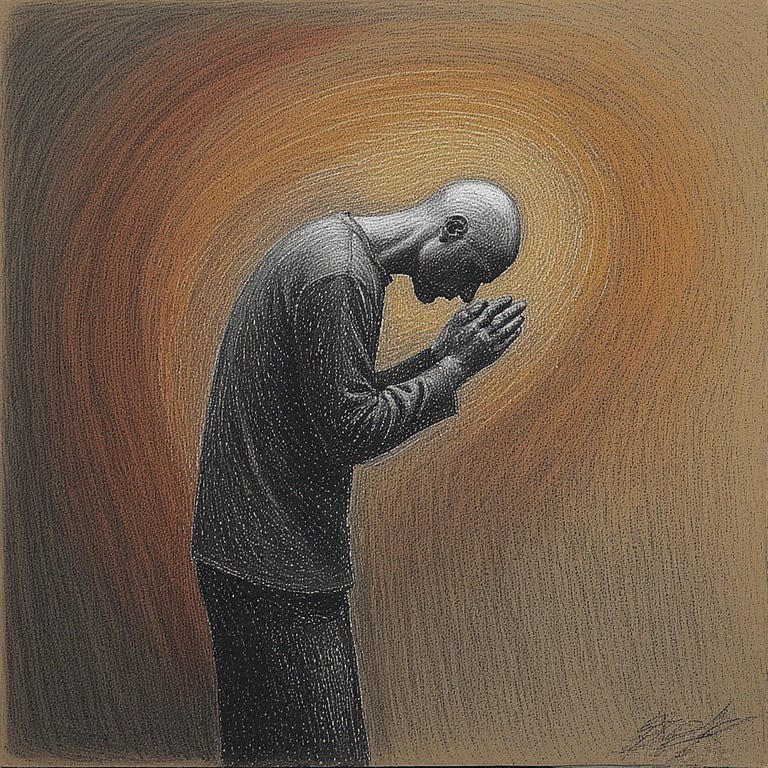
Human cognition is naturally unstable. It drifts, it distorts, it filters selectively, and it builds stories around internal feelings rather than facts. None of this is a moral flaw, it is simply how biological brains work. Without deliberate correction, the mind slowly reorganizes reality around itself, and what it’s closest to, not around what is true.
This is why existential objectivity, the ability to perceive reality in alignment with its actual structure, cannot be sustained passively. It requires regular cognitive recalibration. This is what ritual was originally meant to accomplish before centuries of cultural layering turned “worship” into something sentimental, mystical, or performative. When stripped of mystique, ritual is simply a disciplined practice for realigning perception toward a singular, independent reference point, what we can call the Objective Object, the external anchor that grounds coherence and allows one to see the big picture in order to recognize truth amongst competing perspectives.
Unfortunately, most contemporary rituals no longer point to a single reference. They scatter attention across multiple symbolic targets, cultural narratives, emotional projections, or imagined deities; rife with bias, each with its own perspective, its own demands, its own definition of meaning. When there is more than one reference point, coherence fractures. The mind cannot anchor itself, so ritual devolves into mystical experience, emotional catharsis, or identity theatrics instead of intellectual and emotional calibration. Many traditions have inherited rituals that are beautiful but structurally incoherent: they aim at transcendence without grounding, detachment without direction, affirmation without alignment. The result is ritual that feels profound but does not produce clarity.
Genuine cognitive calibration, however, has identifiable mechanics that align closely with modern cognitive-behavioral psychology.
The first mechanism is deliberate attention toward the Objective Object, an external anchor that is singular rather than multiple. Psychology recognizes this as attentional redirection or metacognitive detachment. Directing focus at a single, independent point interrupts the self-centered loop of rumination, narrative-building, anxiety, and ego-defense. It creates enough psychological distance from internal noise to allow for objective evaluation. Multiple reference points cannot do this; they simply reintroduce noise by competing for the mind’s interpretation.
The second mechanism is positional evaluation, assessing one’s own condition relative to the Objective Object. This resembles cognitive reality testing. Human beings routinely misjudge their importance, helplessness, autonomy, and vulnerability. Some exaggerate themselves; others diminish themselves. Many oscillate between the two. Evaluating oneself relative to a stable, and therefore externally exclusive, singular reference corrects these distortions. It restores a coherent baseline of proportion, dependence, and responsibility, reducing emotional extremes and perceptual bias.
The third mechanism is systemic evaluation, studying how everything else relates to that same singular reference point. This resembles multi-level reframing in CBT. Instead of seeing events as disconnected, chaotic, or personal, the mind begins to analyze situations in terms of structure, interdependence, and underlying coherence. A single reference point allows the big picture to be recognized cohesively; multiple reference points fragment it. This step reduces interpretive noise and helps restore the architecture of meaning by seeing the big picture that otherwise becomes scattered across opinions, ideologies, or emotional reactions.
The fourth mechanism is reflective integration, re-evaluating one’s experiences through the lens of that independent reference. This mirrors cognitive reprocessing. Here, distortions are exposed, interpretations are reorganized, and reactions are aligned with what is real rather than with what merely feels urgent or familiar. Consistency in this practice sharpens discernment and clarifies priorities by reducing the influence of emotional reasoning and narrative manipulation.
Taken together, these practices make coherence a trained competence. Just as physical exercise strengthens the body, ritualized cognitive recalibration strengthens objectivity. Without it, the mind becomes noise-sensitive, narrative-dependent, emotionally reactive, and vulnerable to dissidents; those who exploit cognitive drift for influence or control. With it, the mind becomes stable, pattern-aware, distortion-sensitive, emotionally grounded, and resistant to manipulation.
This explains why earlier societies treated ritual not as an optional cultural flourish but as a necessity. Ritual was not meant to flatter the cosmos; it was meant to maintain sanity. It was a cognitive hygiene routine: a structured pause from self-centered or herd-like thinking, an encounter with an independent order of reality, outside of any and all bias, a scheduled audit of one’s distortions, and a recalibration of the perceptual frame.
But as soon as rituals lose their singular reference point, they lose their function. When the target becomes diffuse, when “worship” means affirming vague transcendence, embracing relativistic detachment, or appealing to multiple symbolic sources, ritual stops producing clarity and becomes mystical, emotional, or merely cultural. Many people today practice rituals that feel meaningful but offer no calibration. The mind leaves the ritual the same way it entered: centered on itself, fragmented in focus, and vulnerable to noise.
Existential objectivity requires exercise. Ritual, properly understood, is the technical mechanism for that exercise. The Objective Object does not require validation. The human mind requires alignment. And alignment is not produced by mysticism or sentiment, but by disciplined, repeated, coherent calibration, always anchored to a singular reference point that is independent, constant, and not defined by anything that exists.