


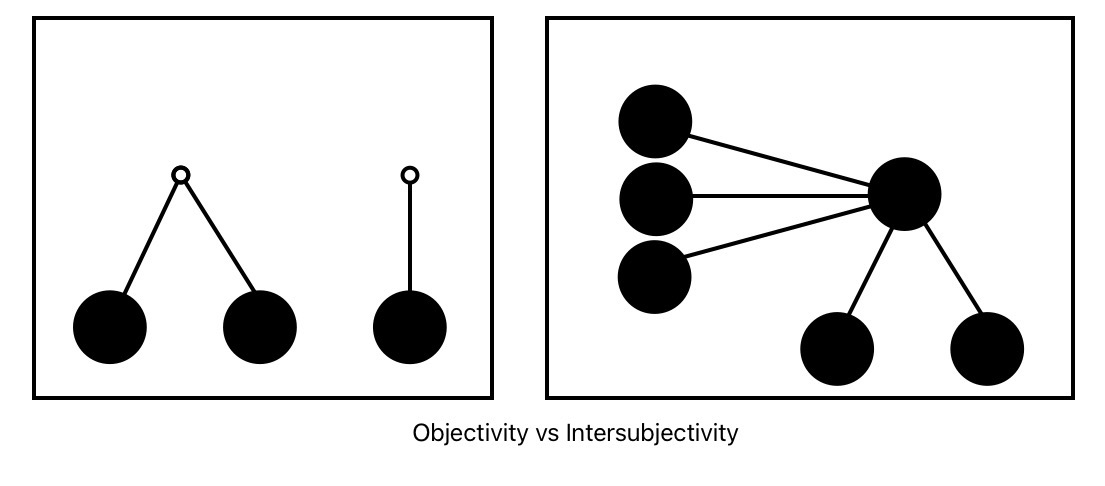
One of the defining ideas of modern thought is that objectivity emerges through intersubjectivity. The argument stems from a false assumption within the scientific method and is pretty straightforward: if enough independent observers examine the same phenomenon, challenge one another’s conclusions, and gradually converge upon the same answer, what remains can reasonably be called objective. This process has undoubtedly contributed to remarkable advances in science, medicine, engineering, and countless other fields.
There is great value in intersubjectivity. It reduces individual bias by exposing our ideas to criticism and correction. It allows communities to accumulate knowledge across generations. It refines explanations by demanding evidence rather than mere assertion. In this sense, intersubjectivity is one of humanity’s greatest epistemological tools.
Yet it is only a tool.
The mistake of modern philosophy is not in recognizing the usefulness of intersubjectivity. The mistake is assuming that intersubjectivity produces the very thing it is actually presupposing.
To understand why, we must first distinguish between consensus and coherence.
Consensus is agreement among subjects. It is produced through observation, discussion, debate, and shared experience. It depends entirely upon the people participating in it. Because of this, consensus can change. It can improve, deteriorate, fragment, or disappear altogether. Entire civilizations have unanimously accepted ideas later proven false. Consensus reflects the current state of collective agreement. It does not explain why reality itself is intelligible.
Intersubjectivity is simply a disciplined form of consensus. Rather than relying upon one person’s perspective, it distributes evaluation across many observers, each correcting the limitations of the others. This makes intersubjectivity extraordinarily effective at discovering error. But discovering error is not the same as producing coherence.
Intersubjective systems become especially powerful because they do more than produce agreement. Over time, they organize agreement into institutions, laws, customs, educational systems, professional standards, and social expectations. Each layer reinforces the others until the entire system begins to resemble objective structure. Rules constrain behavior. Credentials constrain authority. Courts constrain disputes. Scientific peer review constrains publication. Social norms constrain acceptable conduct.
These constraints are real, but they are manufactured, hence they are contingent. They derive their authority from continuing participation in the system. As long as enough people recognize them, they function remarkably well. In this sense, intersubjective systems can imitate coherence by layering consensus until it behaves like an independent constraint.
This is not inherently a problem. In fact, every civilization depends upon such systems. Language, money, traffic laws, legal contracts, universities, and scientific institutions all rely upon intersubjective agreement. They allow millions of people to cooperate without knowing one another personally.
The danger arises when these manufactured constraints lose contact with objective coherence.
A system can become internally consistent while being fundamentally disconnected from reality. Every rule may agree with every other rule. Every institution may reinforce every other institution. Every participant may sincerely believe the system is coherent because it exhibits no obvious internal contradiction. Yet its first principles may be false.
When this happens, the system exists inside a bubble of consensus rather than a framework of objective coherence.
History repeatedly demonstrates the consequences. Financial bubbles often appear stable for years because markets, regulations, institutions, and public confidence reinforce one another; until reality imposes constraints that consensus cannot negotiate away. Likewise, scientific paradigms sometimes persist until observations accumulate that the prevailing framework can no longer adequately explain, prompting a fundamental revision. In both cases, widespread agreement can endure for a long time, but agreement alone does not determine whether a system corresponds to reality.
Consensus can postpone the recognition of incoherence. It cannot eliminate it. Reality eventually reasserts the independent constraints that consensus temporarily obscured.
This brings us back to coherence. Coherence is something altogether different.
Coherence is the presence of an independent constraint that allows relationships to remain intelligible without contradiction. It is what enables one conclusion to follow logically from another. It is what allows mathematics to remain reliable, logic to remain valid, and science to produce repeatable results.
Unlike consensus, coherence cannot be negotiated.
Agreement may recognize coherence, but it cannot create it. The scientific method helps scientists discover coherent features of reality, it does not produce it.
We rely upon this distinction constantly, even if we rarely articulate it. A ruler constrains measurement because it provides an independent standard. Gravity constrains motion regardless of opinion. The laws of logic constrain valid reasoning whether anyone acknowledges them or not. In every coherent system, something stands independently of the system itself and provides the constraint that makes the system intelligible.
This pattern is universal.
Wherever coherence exists, an independent point of reference is constraining the system.
This is why first principles matter. If the foundation is coherent, intersubjective systems become powerful tools for discovering, refining, and applying truth. If the foundation is incoherent, and instead relies upon intersubjectivity, the very same systems amplify error instead. The greater the consensus, the greater the eventual correction when reality can no longer be ignored. A system that foundationally recognizes an independent point of reference that imposes universal constraint upon the system is more robust than a system that foundationally institutionalizes constraint through mere consensus.
Notice what follows.
Whenever someone dismisses a coherent argument without identifying the incoherence, they are not engaging the structure of the argument. They are merely rejecting its conclusion. This has become one of the defining habits of contemporary discourse. Structurally coherent arguments are often dismissed without demonstrating contradiction, creating the illusion that disagreement itself constitutes refutation.
It does not.
This is more than a simple mistake. It is a form of intellectual dishonesty because it discourages structural literacy. It teaches people to evaluate conclusions instead of examining coherence. Over time, this weakens our awareness of objective structure and replaces disciplined evaluation with social acceptance. Confusion becomes easier to maintain because fewer people know how to distinguish incoherence from mere disagreement.
The consequences extend far beyond individual arguments.
Every act of reasoning presupposes coherence. Every scientific discovery presupposes coherence. Every mathematical proof presupposes coherence. Every meaningful sentence presupposes coherence. We do not create this coherence through agreement. We continuously encounter it as the independent constraint that allows our thoughts to correspond with reality.
The question, then, is unavoidable.
If coherence always depends upon an independent constraint, what accounts for the coherence of existence itself?
Consider the totality of everything that exists.
Every distinguishable thing belongs to this totality. Every particle, every galaxy, every field, every law we discover, every observer, every idea, every measurable phenomenon exists within the same domain. Nothing contained within the totality can stand outside the totality to constrain it.
Yet the totality is coherent.
The universe behaves in ways that are intelligible. Logic applies. Mathematics describes reality. Scientific investigation succeeds precisely because reality consistently constrains our expectations. Things make sense.
Existence is actively relying upon a coherence that existence alone cannot explain. At this level, only an independent point of reference can account for the coherence we are continually experiencing.
The moment we ask what such a reference must be like, its characteristics are no longer arbitrary. They are dictated by the very structure of coherence itself.
It must be singular. If there were multiple ultimate constraints, each would require another standard to reconcile them, meaning neither would be ultimate.
It must be external. A reference contained within the system cannot constrain the entire system from which it derives.
It must be universal. A constraint that applies only sometimes or only somewhere cannot account for the coherence of reality as a whole.
It must be non-derived. If its existence depends upon the system it explains, then it cannot explain that system.
It must be invariant. A changing reference cannot consistently constrain a changing reality.
And it must be independent. If what it constrains can influence or determine it, then it is no longer the objective constraint but merely another participant within the system.
These are not theological assumptions. They are the necessary conditions that satisfy the coherence we continually experience, objectively.
Now consider one final implication.
Human knowledge continually expands. We discover new galaxies beyond previous observation. We uncover quantum phenomena that challenge our intuition. We identify new particles, new structures, and new relationships. Every discovery enlarges our understanding of what exists.
But every discovery shares something in common.
Once discovered, it becomes one more distinguishable feature of existence.
It joins the set.
It does not become the independent point of reference that explains why the set remains coherent.
The very moment something possesses distinguishable characteristics, it exists as one more member of reality rather than as that which constrains reality itself.
The independent constraint can never become another object among objects. It continually stands beyond the edge of perception, not because it is hidden somewhere waiting to be discovered, but because it is not the kind of thing that belongs to the domain of distinguishable existence at all. It is the condition that makes distinguishable existence possible.
This exposes a profound limitation in contemporary discourse.
Modern philosophy increasingly confines itself to questions of language, knowledge, and experience. Modern theology largely confines itself to defending doctrines, comparing traditions, and preserving systems of belief. Both disciplines have largely abandoned the prior metaphysical question: what are the necessary conditions that makes coherence objectively possible in the first place?
The result is that metaphysics has been displaced.
Theology protects doctrines instead of examining the structure that would make any doctrine objectively true. Philosophy often analyzes concepts without asking what reality must be for those concepts to remain coherent. Meanwhile, secularism retains objectivity only where it is useful—as a methodological tool for science and technology—while denying it as a universal ontological principle governing existence itself.
Objectivity becomes something we use rather than something reality is. Objectivity gets reduced to a mere tool.
But coherence refuses to obey those boundaries.
Every scientific experiment presupposes it. Every logical inference depends upon it. Every truthful statement reflects it. Every successful prediction confirms it.
Intersubjectivity does not create this coherence. It merely helps us recognize a coherence that was already there.
Consensus can discover coherence.
Consensus can approximate coherence.
Consensus can even ignore coherence.
But consensus can never produce coherence.
Reality is coherent before anyone agrees that it is. And it is only because that coherence stands independent of us that truth, logic, knowledge, and understanding remain possible at all.
This is why coherence cannot be reduced to consensus. Consensus only tells us what people agree upon momentarily. Coherence tells us whether that agreement is actually constrained by reality. A unanimous belief can still be incoherent if it violates the independent structure it claims to describe.
This is what theism ultimately affirms. It is not merely the claim that a god exists. In fact, God does not exist because existence is contingent. Instead, God is real because coherence is real. Theism is suppose to be the recognition that objective coherence has an independent source. That independent source is what makes logic, truth, knowledge, and reality itself intelligible. Without it, there would be no objective constraint, only shifting consensus. Yet we do not inhabit a world of mere consensus. We inhabit a world whose order continually constrains our beliefs, whether we acknowledge it or not.