


Human beings have always asked the question of being: What does it mean to exist? Philosophy has given us countless tools to think about this: concepts of essence, substance, causality, and contingency. Theology has historically tried to situate God in this discussion, often through debates over attributes, doctrines, and metaphysical systems. But both philosophy and theology, in their traditional forms, often miss the essential task: an objective ontological analysis of being.
Philosophy is indispensable for clarifying concepts and sharpening reason. But it remains an exercise within the horizon of human thought. It analyzes ideas about being rather than engaging the fact of being itself. This is why so many philosophical systems remain suspended in debate, endlessly revising frameworks without reaching bedrock. They describe, compare, and speculate, but they rarely establish the necessity of an impartial reference point that grounds being itself.
Theology, in its historical forms, has also obscured the question. Too often it anthropomorphizes God, making Him “a being among beings,” and in doing so opens the door to skepticism. When God is treated as one more thing within the set of things, subject to comparison and critique, He is no longer the objective ground of existence but a character within the story. This is why theology as an academic study of comparative religions tends to multiply speculation rather than resolve it.
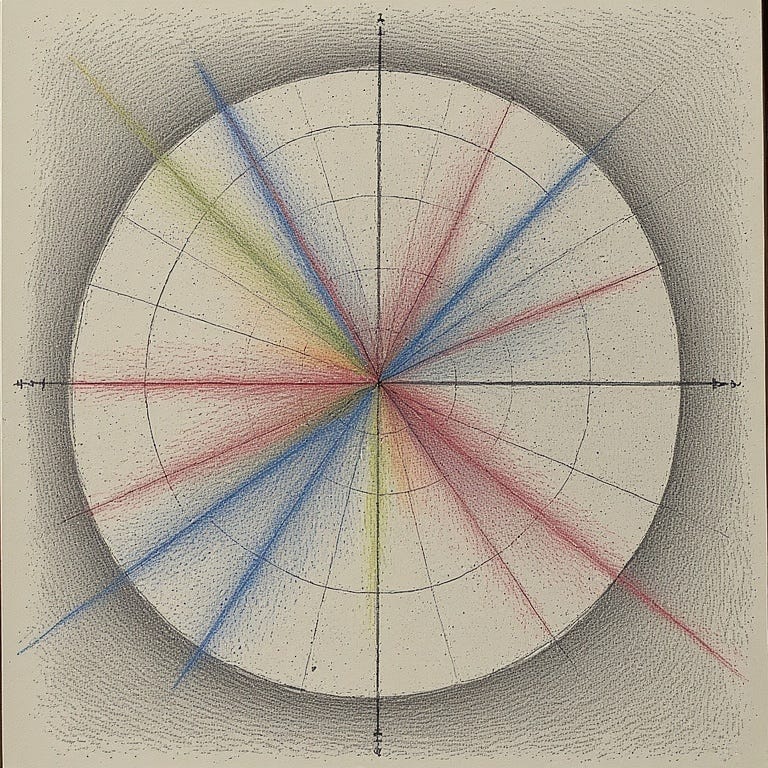
An objective ontological analysis begins elsewhere. It recognizes that everything that exists is contingent; each thing depends on something else for its existence. The universe is a web of interdependent beings, none of which sustain themselves. The contingency of existence underscores the need to observe being objectively. To do so, being must be conceived as a vector: its magnitude expressing existence equally, its point marking the non-contingent source. Historically and anthropologically, humanity has always sought to recognize this source as God, the objective anchor of being. In this framing, universal rights are grounded in the very fabric of existence itself, transformed into a science of objective reason, with the same rigor we place in all academic pursuits, that resists manipulation by fleeting narratives or the will of the powerful, offering the most reliable foundation for international human rights.
This vector is not an “idea” or “invention.” It is the necessary precondition for coherence itself. Without it, there would be no trail of logic, no intelligibility, no order to discover. The fact that coherence exists—that mathematics holds, that causality persists, that reason functions—demonstrates that being is not random chaos but grounded coherence.
To ask whether this reference point “exists” is an absurdity. The question itself is a sleight of hand, it distracts from recognition by turning necessity into speculation. What makes this misdirection effective is that it imports the wrong standard of proof. One cannot demand empirical evidence for the very condition that makes empirical evidence possible. To ask for “scientific proof” of the vector of being is to confuse categories, it is like demanding a ruler measure itself without any reference point.
And yet, this is exactly how discourse has been steered. In psychology, for example, we practice objective analysis without demanding material proof for the reality of subjective experience. The field recognizes that thoughts, emotions, and behaviors can be studied objectively even though they transcend laboratory measurement. This is an industry standard, accepted without controversy. But when the same mode of objectivity is applied at the level of being, it is relegated to theological discourse and privatized. The reason is not intellectual but political: an honest discourse on the objectivity of being would make secular frameworks transparent, scalable, and quantifiable. It would expose the fact that secularism rests not on neutrality, but on a selective skepticism that keeps its own foundations hidden from critique.
Secularism has, intentionally or not, created a system in which objective ontological discourse is delegitimized or displaced. By framing ultimate questions of being as “theological” or “speculative,” secular narratives effectively move the study of reality from the public sphere into a narrow, often doctrinal space. This theologization of ontological analysis does two things: first, it obscures the objective framework that could make rights, justice, and coherence transparent and non-negotiable; second, it externalizes responsibility for understanding being, forcing humans to defer to institutions, experts, or belief systems rather than engaging with the very foundation of existence themselves.
In other words, secularism redirects inquiry away from the necessary vector of being and toward human-mediated interpretations. By doing so, it hides the mechanisms that ground coherence, rendering populations unaware of the ontological constant that underpins their own rights, dignity, and the moral logic of the universe. The veil of skepticism, that being cannot be objectively analyzed, ensures that violations, inequities, and abuses can continue unchecked. People are encouraged to debate opinion, policy, or ethics, while the deeper architecture of reality remains obscured.
The neglect of objective analysis of being has profound consequences. When rights are grounded in consensus, politics, or cultural convention, they become fragile. What is granted can be revoked; what is recognized in one context can be denied in another. Power, not truth, becomes the arbiter.
But if rights are grounded in being itself, they are not negotiable. The right to exist is not a social contract but an ontological fact. Every human being’s dignity flows from the same vector of being. Any denial of this is not merely political injustice but ontological incoherence.
Contemporary examples demonstrate the stakes. Mass digital surveillance treats individuals as data points rather than beings with dignity, violating privacy because rights are interpreted through mutable policy rather than anchored in being. AI algorithms perpetuate bias, scaling discrimination because objective grounding is ignored. Refugees and displaced populations are treated as political variables, their rights deferred to convenience and expediency. These violations are not simply ethical lapses; they are incoherencies in reality, enabled by the systematic evasion of ontological analysis.
Case Study 1: Slavery
In societies where rights were defined by law or custom, enslaved people were legally stripped of dignity and treated as property. The logic was self-serving, rights were distributed according to economic and political interests, not grounded in being.
But through the lens of objective ontological analysis, slavery is incoherent. The enslaved person shares the same vector of being as the enslaver. To deny this equality is to deny the ground of coherence itself. No power structure, no cultural norm, no economic justification can override that.
This does not mean the differences between people, in culture, capacity, or skill, are erased. It means that such differences are secondary to the deeper fact of shared being. Rights are not earned by usefulness, they are given by existence. And because existence itself is not contingent on human judgment, neither are the rights that flow from it.
Case Study 2: Environmental Rights
A similar distortion arises in how humanity treats the environment. Forests, rivers, and ecosystems are often regarded as resources to be consumed rather than beings with integrity of their own. When rights are grounded only in human law, nature is protected only insofar as it serves human preference or survival.
But through objective ontological analysis, the environment has value because it, too, participates in being. Each ecosystem is part of the same coherent order, sourced from the same vector. To destroy it recklessly is not simply a matter of poor stewardship, it is a violation of coherence itself.
This doesn’t mean humans cannot use resources or alter their environment. It means such use must remain coherent: proportionate, balanced, and consistent with the integrity of the system itself. The moment exploitation disregards this order, it ceases to be rational and collapses into incoherence, a kind of ontological vandalism that rebounds back upon human existence.
Case Study 3: Women’s Rights
Throughout history, cultures have often tied women’s rights to social roles, traditions, or economic utility. This left their dignity vulnerable to shifting norms, with their worth defined relationally, as daughters, wives, or mothers, rather than as beings in themselves.
An objective ontological analysis corrects this distortion. A woman’s existence flows from the same vector of being as a man’s. Her rights are not derived from culture, law, or function but from being itself. To treat her as lesser, secondary, or dependent on societal definitions is to deny the coherence of reality.
At the same time, men and women display distinct characteristics and tendencies. Objectivity does not deny these differences, it accounts for them. A coherent society must make space for each to flourish according to their design, rather than suppress difference in the name of uniformity. This discernment is complex, requiring us to distinguish between natural realities and cultural distortions. But it is precisely the kind of complexity that an ontological foundation makes possible. Without it, discussions about equality collapse into endless battles between sameness and superiority.
Here we glimpse what society misses when it avoids objective ontological discourse. The question is not whether men and women are identical, but how their shared vector of being requires equal dignity while their differences require thoughtful accommodation. Only through objective grounding can this balance be maintained without drifting into arbitrariness or power struggles.
Philosophy sharpens our tools of thought. Theology reminds us that there is more than materiality. But objective ontological analysis anchors both. It is the recognition that being itself is coherent, grounded in one transcendent reference point.
Religion, at its best, is the practice of aligning human life with this recognition. Its role is not to multiply doctrines but to orient us to the vector of being, to remind us that coherence is not human invention but objective reality.
Secularism, by contrast, systematically redirects this inquiry into theology or doctrinal debate, forcing humans to treat the study of being as speculation rather than objective analysis. This theologization shields institutions and authorities from responsibility: it hides the vector of being, obscures the coherence of reality, and allows violations, inequities, and exploitation to persist unchallenged.
Without this grounding, society drifts into relativism, where rights become negotiable and coherence dissolves into competing narratives of power. With it, we gain a compass: a way of discerning justice, grounding rights, and living in alignment with the reality we cannot control but must recognize.
This is why an objective analysis of being is indispensable. It secures the foundation of coherence, justice, and truth, and it reveals that the pursuit of objectivity is not optional, but the only way to live meaningfully within reality. Avoiding it, hiding it, or theologizing it is not a neutral oversight. It is a strategic mechanism that allows systems of power to scale, govern, and dominate while leaving humanity blind to the fundamental architecture of existence.