



The “Objectivity vs Theology” series explores how different theological categories undermine or confuse the foundational role of objectivity. Here is the list of current themes: Deism, Atheism, Agnosticism, Polytheism, Monotheism
Any domain that preserves logic must preserve objectivity. This is not a theological claim; it is a structural one. Objectivity is the condition under which reasoning is possible at all. When objectivity is blurred, logic does not merely weaken, it collapses into ambiguity, contradiction, and eventually power.
Pantheism and panentheism both fail at this level. Not because they are emotionally unappealing or spiritually unsatisfying, but because they conflate the object with the subject, erasing the very distinction that allows coherence to exist.
To see why this matters, we must first be precise about what objectivity requires.
An objective reference point must be:
Singular, there cannot be competing or parallel “objective” standards.
Universal, it must apply across the system without exception.
Distinct from what it evaluates
External to the set of subjects it grounds
Independent of their variation or disappearance
Non-derivative, meaning it is not produced by the system it governs
Objectivity is not “everything being connected.” It is everything being measured by the same external reference.
This distinction—between object (that which grounds coherence) and subject (that which is grounded)—is not optional. It is the backbone of logic itself.
Pantheism
Pantheism is often summarized as “God is the universe.” At first glance, this can sound profound. But structurally, it hides a fatal ambiguity.
There are two very different claims that can be smuggled under this sentence:
Coherent version (acceptable):
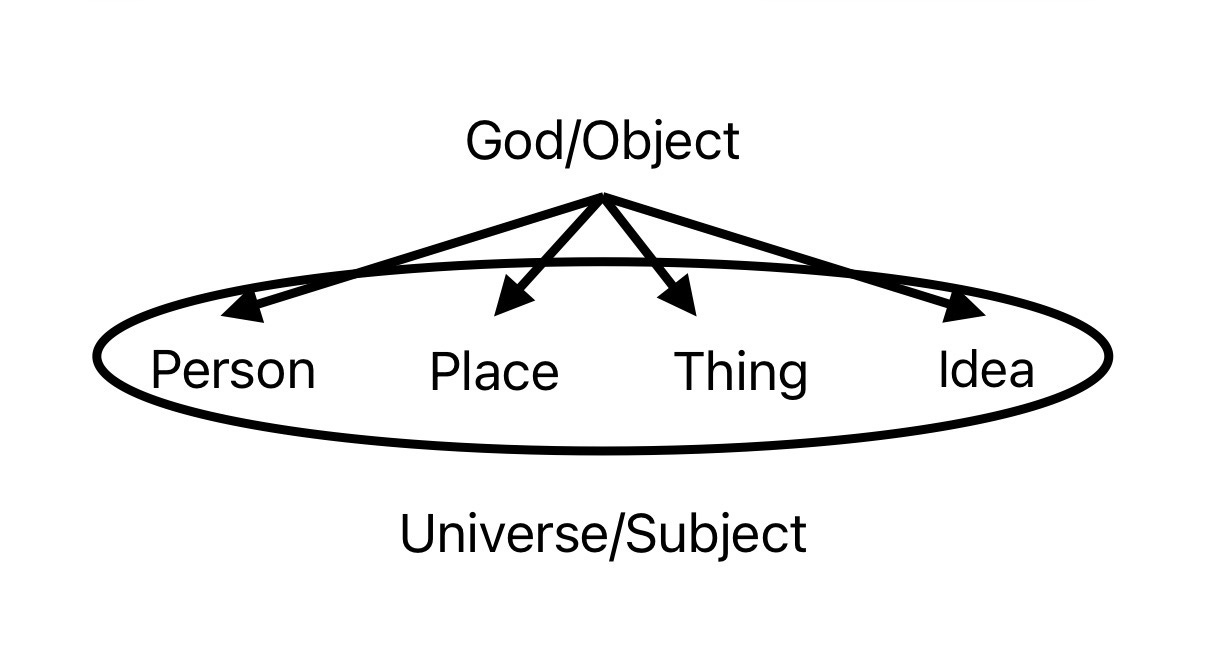
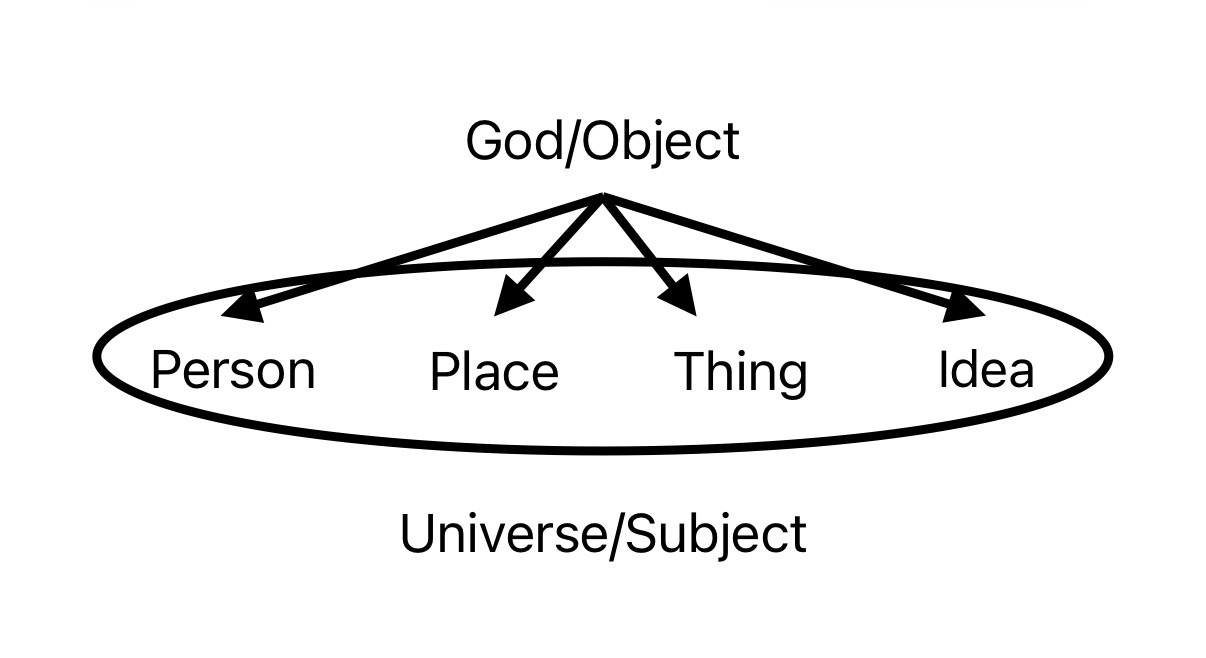
God is the creator and sustainer of everything that exists; nothing exists apart from Him. If it exists, God is its creator, objectively.Here is an illustration to represent this construct:
Incoherent version (actual pantheism):
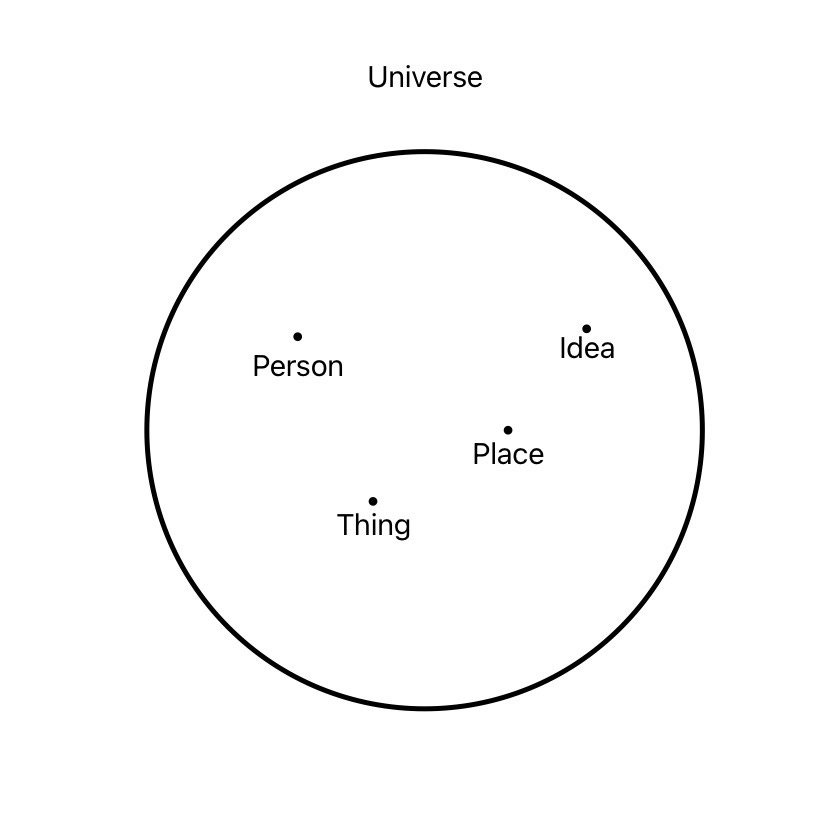
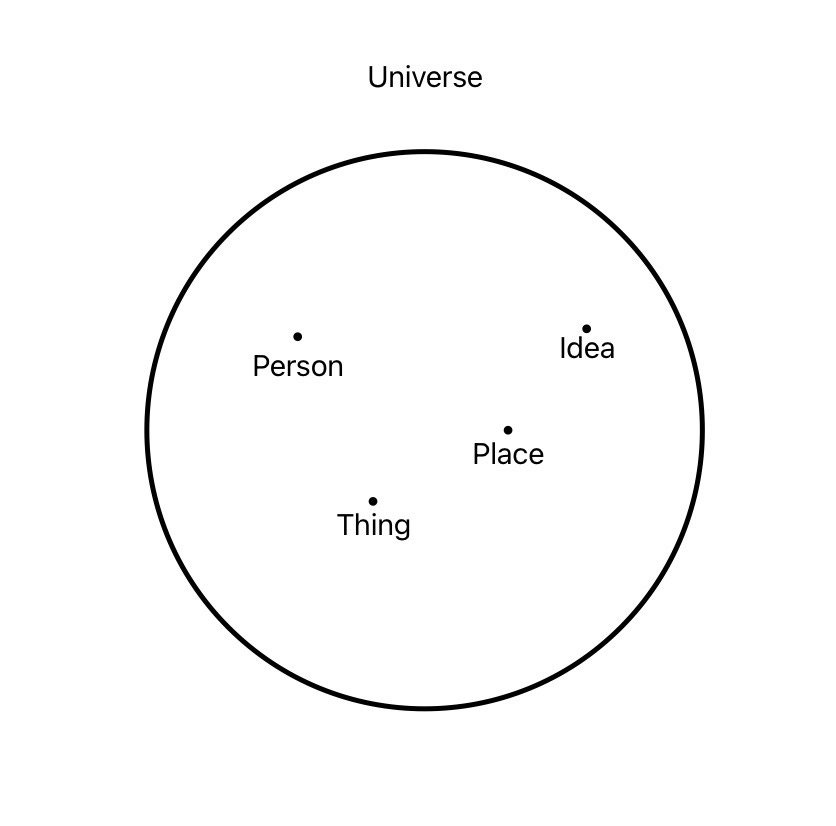
Everything that exists is God.Here is an illustration to represent its construct:
This second claim collapses objectivity.
In this structure:
Every subject is also the object (The object/subject construct is not clearly defined)
Every contradiction is internal
There is no standard by which coherence can be evaluated
If everything is equally God, then nothing can be measured, corrected, or judged without circularity. Reason becomes self-referential narrative. Logic dissolves into poetic association.
Pantheism does not elevate the universe, it flattens objectivity.
Why and When Anthropomorphic Language Matters
Modern discourse often misconstrues and mocks terms like “above,” “outside,” or “beyond” as primitive or spatially naïve. But this is a category mistake.
These terms are structural markers, not spatial claims.
Saying the object is “outside” the system means:
It is not reducible to the subjects
It is not interchangeable with them
It is not consumed by their variability
Removing this language does not make thought more sophisticated, it makes it structurally blind.
Without distinction, like pantheism does, everything collapses into subjectivity.
Panentheism
Panentheism attempts to repair pantheism by saying:
God is the universe and more.
But this does not restore objectivity, it obscures its loss even further into an egg shaped analogy:
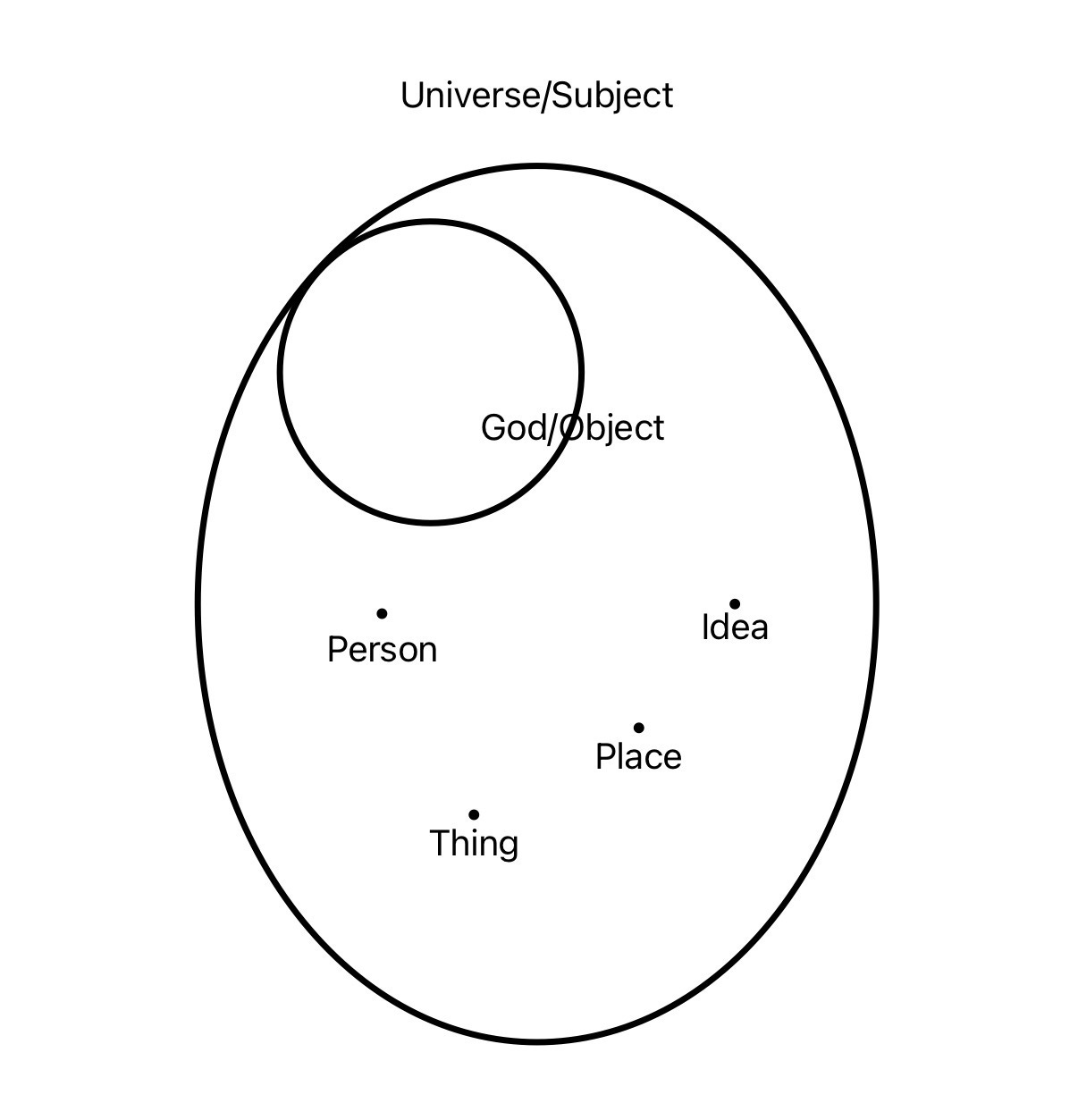
This structure feels hierarchical, but it still fails:
God is still partially constituted by the universe
The object still contains the subjects
The grounding reference is entangled with what it grounds
There is no clean separation. No true externality. The object is still inside the system it is meant to grant coherence to.
This is why panentheism relies heavily on semantic elasticity—terms like “participation,” “manifestation,” or “expression”—to mask the unresolved logical contradiction.
Why This Matters
When objectivity collapses:
Logic becomes negotiable
Contradiction becomes aesthetic
Power replaces truth
This is not accidental.
Modern secular discourse often celebrates “reason” while quietly dissolving the objective conditions reason requires. By blurring object and subject, it creates endless semantic noise—debate without resolution, critique without grounding.
This is how truth becomes procedural, rights become negotiable, and coherence becomes optional.
The Necessary Structure of Objectivity
Let’s revisit the coherent structure of objectivity:
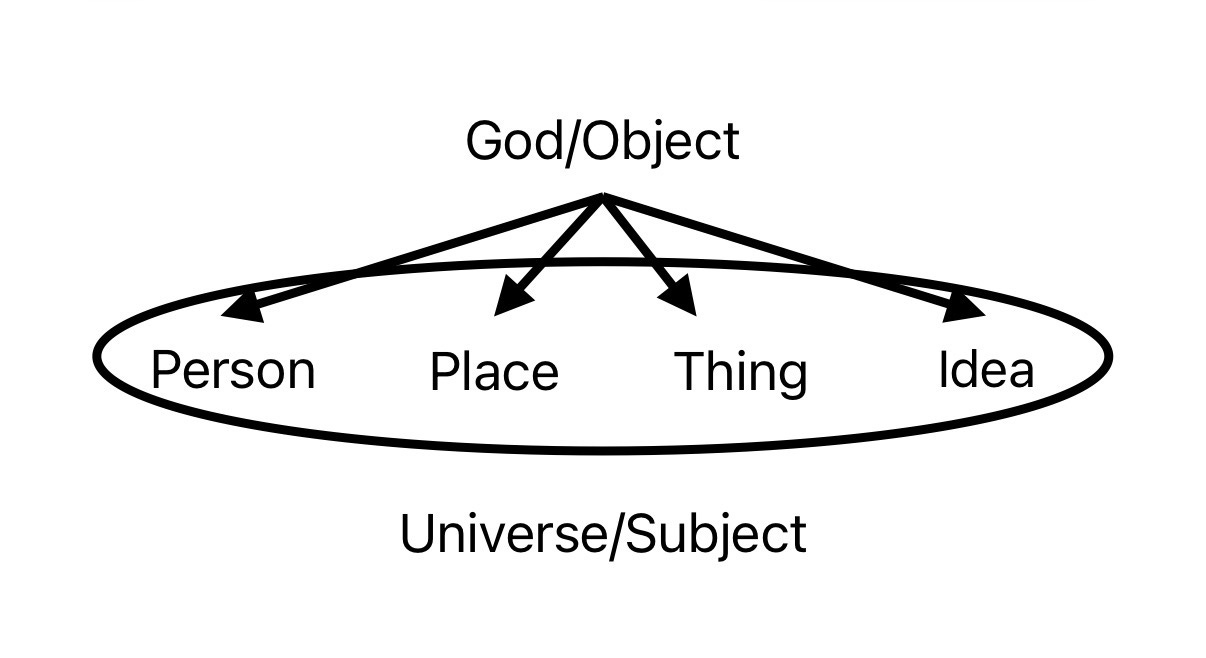
This structure preserves:
Equality among subjects
Coherence across the system
Logic as a real, operative force
God, as the objective reference point, must remain distinct from the universe, not because God is distant, but because logic requires distinction.
God can be present to everything without being identical to everything. Presence does not require identity. Grounding does not require absorption.
The Metric System: A Real-World Example of Objectivity
Consider the meter.
Today, a meter is defined in relation to an objective constant:
the distance light travels in a vacuum during a fixed fraction of a second.
We can illustrate the meter as a coherent system within the physical domain of length like we represent objective logic as the coherent system within the physical domain of the universe:
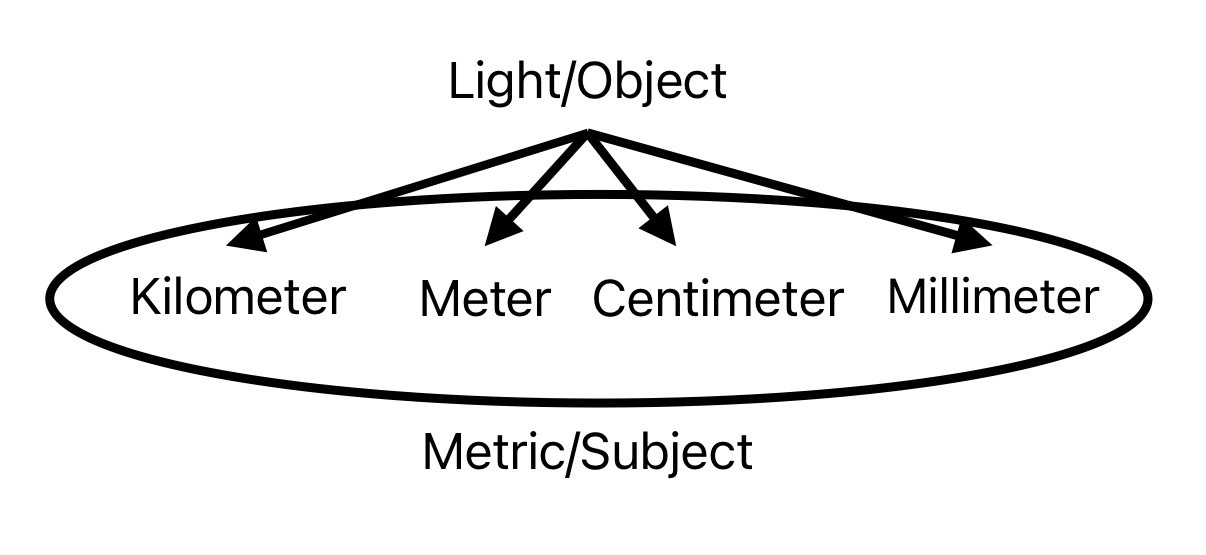
It is important to note that the meter is irrelevant outside the domain of light. No contingent property can be absolute in itself. When the domain expands, these “objects” reveal themselves as subjects, not foundations.
In other words, light is not the source of objectivity, it is structured by it.
Now imagine:
All rulers disappear
All metric units are forgotten
All human measurement systems collapse
What happens to the object?
Nothing.
The speed of light remains unchanged. The grounding reference persists independently of our representations.
This is objectivity.
Why Pantheism and Panentheism Fails This Test
Pantheism treats the measurement system and the object as identical.
If light was the meter, then destroying the meter would destroy light itself. But that’s not how coherence works.
The object must outlive its representations.
Panentheism fares no better; it embeds the object inside the system, making it partially dependent on what it grounds. When attempting to articulate objectivity in respect to the universe, it is illogical.
Pantheism and panentheism do not merely offer alternative spiritual intuitions. They reconfigure the structure of objectivity in ways that make coherence impossible.
Once the object becomes the subject:
Logic loses its footing
Reason becomes narrative
Power fills the vacuum
This is why so much cultural effort is spent blurring objective awareness. A society that forgets how objectivity works cannot challenge incoherence, it can only manage it.
Objectivity is not oppressive.
It is what allows truth to exist at all.
It only benefits where the object remains well defined: singular, distinct, external, and grounding, never absorbed into the system it makes intelligible.
And in the end, that is the real function of these narratives: to make foundational clarity seem distant, obscure, or optional so that people no longer recognize the root of their own reason. A population unable to trace truth to its foundation is a population easy to manipulate; standing on a ladder suspended in air, not noticing that the ground is gone, and convinced that climbing higher will lead them to somewhere real.