

In our everyday lives, we rely on truth and facts to make decisions, solve problems, and navigate the world. From the simple act of checking the time to more complex judgments like determining the validity of a claim, coherence is the backbone of these decisions. Coherence ensures that the pieces of information we gather fit together in a consistent and reliable way, allowing us to form judgments that align with reality. Without it, everything would collapse into confusion, as facts would no longer hold together in a way that reflects the world we live in.
Truth is more than just a belief or opinion, it is the correspondence between our understanding and reality. For something to be true, it must align with the structure of the world as it actually exists. In essence, truth is determined by how well a statement or belief fits into the larger system of facts, with coherence acting as the key to ensuring that all parts of this system hold together. Facts are the building blocks of truth. When these facts are coherent, they form a reliable structure that accurately reflects reality. This coherence is not just a matter of consistency; it is the very fabric that allows reality to be understood in a way that is stable, predictable, and meaningful.
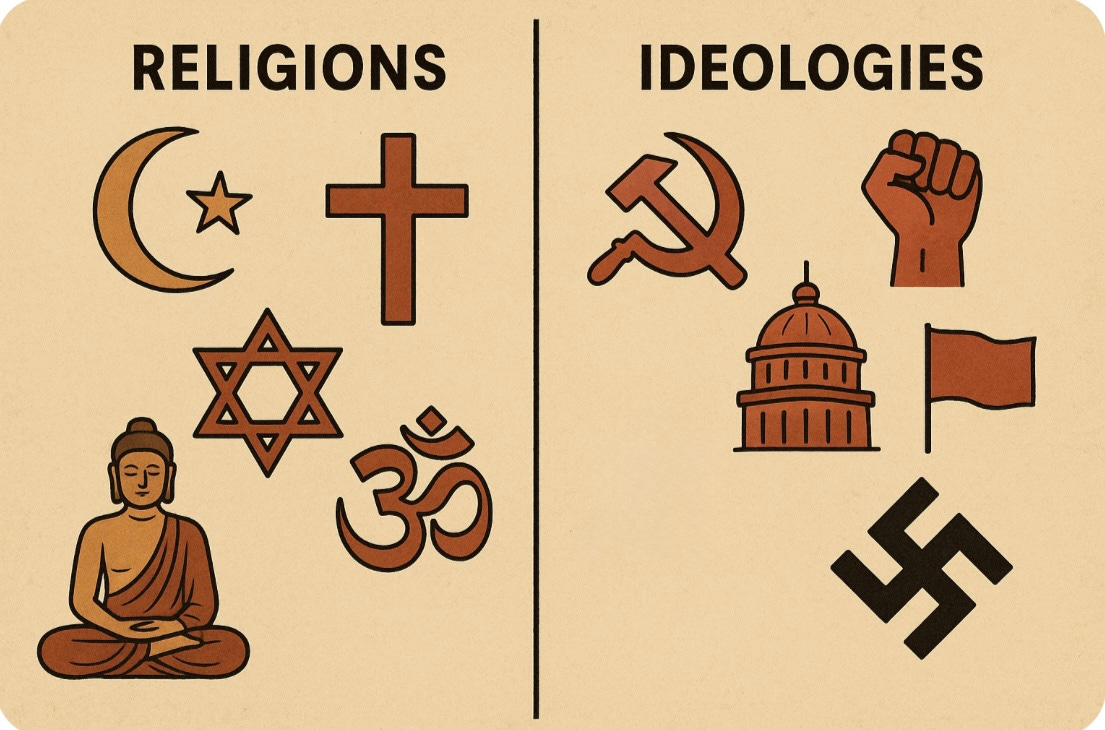
Now, consider two systems: religion and ideology. Both aim to provide a framework for understanding and navigating the world, but they differ fundamentally in how they approach coherence and the determination of truth.
At its core, religion is an attempt to extend the search for coherence beyond the immediate facts of life into the whole of existence. Rather than grounding truth only within the shifting patterns of the world, it begins with the premise of a creator or transcendent source, a foundation outside the contingent set of reality. This move situates value in being itself, establishing a reference point that allows for the impartial evaluation of everything within existence.
The strength of this approach is that it aims to perform meta-analysis. By anchoring truth in something beyond the flux of contingent events, religion opens the possibility of assessing the totality of reality against an objective standard. In principle, this provides a framework that can preserve coherence at every level, from the smallest fact to the largest question of meaning.
Yet most religious traditions fail to maintain this consistency. While they may begin with a transcendent source, they often introduce contradictions, cultural mythologies, or interpretive biases that compromise the very objectivity they seek. Instead of preserving a framework capable of evaluating the entire pool of existence impartially, they collapse back into selective systems that privilege particular perspectives or narratives.
In other words, religion in its purest sense is the attempt to establish coherence universally by grounding it in what transcends existence. But only a framework that consistently maintains this coherence, without deviation or contradiction, can truly fulfill that role.
Ideology takes a different route. It does not attempt to analyze reality from outside the contingent set, but instead encloses truth within the system itself. It treats validity as a matter of internal consistency and consensus, rather than as something grounded beyond the boundaries of the system.
Practically, this means ideology depends on a tautology at scale: it assumes that the order it establishes is self-validating. The universe of discourse is artificially constrained to a defined set, with boundaries drawn by institutions, authorities, or prevailing opinion. Inquiry that seeks to examine the system as a whole (its premises, assumptions, or ultimate grounding) is either dismissed as irrelevant or restricted outright.
The danger of this move lies in how coherence is truncated. Coherence, properly understood, is recursive: it works backward as well as forward. If the root premise of a framework is incoherent (say, because it relies on circular reasoning) then no amount of downstream alignment can redeem it. An edifice of thought built on a compromised foundation may appear consistent on the surface, but it collapses under scrutiny because its first principles cannot sustain universal evaluation.
Ideology, by restricting inquiry to within its own enclosure, evades this problem not by solving it but by silencing it. It redefines coherence as consensus, transforming truth from an objective measure into a product of power.
To see the difference between meta-analysis and tautology more clearly, consider the simple case of a map.
A map is meant to represent the territory. If the map is accurate, it aligns with the terrain; if not, it fails its purpose. A meta-analysis of the map would mean testing it against the territory itself; checking whether roads exist where the map says they do, whether the distances measure up, whether landmarks correspond to reality. This is the religious posture at its best: an attempt to step outside the enclosed system of the map and ground coherence in something greater than the representation itself. The authority of the map derives not from itself, but from its correspondence with the real terrain.
Ideology, by contrast, operates as if the map is the territory. Within the enclosure of the map, all validation is internal: the streets connect, the symbols are consistent, the scale looks uniform. As long as you do not question whether the map matches the real world, the system appears perfectly coherent. But the moment you ask whether the map corresponds to the actual terrain, ideology falters—because its coherence has been redefined as conformity to itself, not alignment with reality.
This same pattern holds at larger scales. Religion, at its best, is the meta-analysis over the pool of all being, the universe, objectively. It is like performing a vector analysis on being itself in order to scale the universe consistently. Unlike closed systems that pretend to fix their boundaries, religion at its best works dynamically: since absolute zero is not empirically provable, the universe cannot be reduced to a static endpoint. Instead, religion provides a framework for analyzing existence as it waxes and wanes with human understanding, ensuring that coherence is never lost even as knowledge evolves. This makes it possible to navigate coexistence transparently, to align governance with reality rather than with hidden dominance, and to acknowledge natural hierarchies without allowing them to calcify into artificial ones.
Ideology, by contrast, traps analysis within the system itself, where coherence is reduced to conformity. The former preserves an opening to reality itself; the latter closes it off, mistaking internal order for truth.
The contrast between religion and ideology reveals what is ultimately at stake: our shared ability to recognize reality as it is. A genuine meta-analysis of existence, one that grounds coherence in a transcendent anchor, preserves human agency at the highest level. It allows individuals and societies to evaluate not just their place in the world, but the world itself, against a standard that is impartial and unmanipulable.
Ideology, on the other hand, eliminates this safeguard. By collapsing coherence into consensus, it places the right to define reality in the hands of those who control the system. The common person is left to navigate existence not by truth, but by the shifting tides of opinion, fashion, and institutional decree. In effect, they sign away their right to be grounded in reality itself, resting their existence on the authority of others.
This distinction is not abstract. Reality is the landscape we all share. If truth is measured only by consensus, then reality itself becomes vulnerable to manipulation. But if coherence is preserved all the way down to its root, then truth remains accessible—an anchor that secures not only knowledge, but freedom, dignity, and the very possibility of shared existence.