

Objectivity is not a mood, an attitude, or a stylistic preference. It is the logical necessity for coherence, which enables different people, at different times, to reliably evaluate the same thing and reach the same conclusion. Whenever we calculate, diagnose, measure, plan, or communicate, we rely on this stabilizing framework. This framework has very strict criteria:
Singular – there cannot be competing or parallel “objective” standards.
External – it must stand outside the system it evaluates.
Independent – it cannot depend on the system’s internal opinions, desires, or politics.
Universal – it must apply across the system without exception.
Invariant – it cannot shift with context, power, or preference.
Non-derivative – it cannot be grounded in anything in the system, because nothing in the system is self-justifying.
If any of these criteria fail, objectivity collapses into preference, and preference collapses into power exercised thru brute force. Every functioning society, every working discipline, every stable judgment, and every meaningful measurement depends on these criteria. We do not get to opt out of objectivity because the alternative is incoherence. Without coherence, logic can’t exist.
Mathematics is the clarified form of this truth. It is logic expressed quantitatively, making visible the structural demands we otherwise take for granted. Math does not invent objectivity, it reveals the internal architecture objectivity requires: consistency, stable definitions, shared reference points, and non-contradiction.
To illustrate why this matters, we will demonstrate with three formal domains in math: set theory, graph theory, and Gödel’s incompleteness theorems.
SET THEORY
Set theory is one of the most widely used foundations across mathematics and industry today. Databases, programming languages, cryptography, search engines, machine learning pipelines—all of them rely on set-theoretic logic, even when abstracted away.
A set is a collection of elements together with the rules you use to evaluate membership.
Take the set:
S = {apple, banana, grape}.
We classify S by the objective rule “is a fruit.”
Here is how the six criteria of objectivity apply directly to the set itself:
Singular
There is one shared rule governing membership in S:
x ∈ S ↔ x is a fruit.
There are no competing or multiple criteria.
External
The rule does not come from inside S or from any of its elements.
Apples do not define “fruit.”
The definition comes from a principle outside the set: botanical structure.
This ensures the set isn’t self-referential.
Independent
Membership in S does not depend on the relationships, behaviors, or preferences of the individual items.
Apple doesn’t “vote” banana into the set.
Grape doesn’t depend on apple to stay a fruit.
Each element independently satisfies the rule, and the rule applies regardless of internal dynamics.
Universal
The criterion applies uniformly to every element of the set.
Apple satisfies the rule “is a fruit.”
Banana satisfies it.
Grape satisfies it.
There are no exceptions inside the set.
The rule applies to each member in the same way.
Invariant
The rule remains the same across all evaluations of the set.
Whether we examine S now, tomorrow, or in a different logical context:
The definition “fruit” remains the same
And thus the membership of S remains the same
The rule does not shift depending on the order of elements, the person evaluating them, or the internal relationships between the items.
Non-derivative
The criterion does not depend on any particular member of S.
If apples went extinct, “fruit” would still mean what it means.
The rule is not built from the members; the members are included because of the rule.
This means the set’s coherence does not depend on any specific item in set S. Coherence emerges from fruit. Therefore, we can call this set fruit. It is singular, external, universal, invariant, and non-derivative. Now we test objectivity by adding a new element:
Add: carrot
At first glance, carrot does not belong, because the objective category “fruit” has a universal biological criterion: a seed-bearing structure formed from the ovary of a flowering plant.
Carrot is a root vegetable, not a fruit.
If we insist carrot is fruit, implying multiple truths, the set becomes incoherent:
The classification rule fails.
Membership loses meaning.
Evaluation collapses.
This is what it looks like when objectivity breaks.
But notice something deeper: sometimes our awareness is what changes, not reality.
If someone intends the set to represent edible vegetation, or food grown from plants, then the objective structure must be reconciled by expanding the category:
S’ = {apple, banana, grape, carrot} under the objective category “edible vegetation.”
Coherence is restored not by denying objectivity but by correctly calibrating the objective structure to reality.
This is the pattern:
Contradiction reveals the category was too narrow.
Expanding the objective reference point restores coherence.
Objectivity is not fragile, our understanding is. But notice how the objective standard, edible vegetation, does not reduce the diverse traits of any element within set S. Carrot can remain orange (or purple, yellow, or white), grape can continue to grow on a vine, and banana doesn’t stop apple from being crunchy. Every element within the set remains what it is and clearly recognizable. Edible vegetation does not impose on the set, it only grants coherence to the set.
GRAPH THEORY
Graph theory powers logistics networks, Google Maps, internet routing (BGP), neural networks, fraud detection, and supply chain optimization.
Using the same set from the previous section:
S = {apple, banana, grape}
Graph theory lets us visualize objectivity as structural equality.
A graph is simply a set of nodes connected by edges that represent relationships.
Here we represent:
each item (apple, banana, grape) as a node
the objective rule (fruit) as a parent node
and each item connects to that parent by a single, coherent edge:
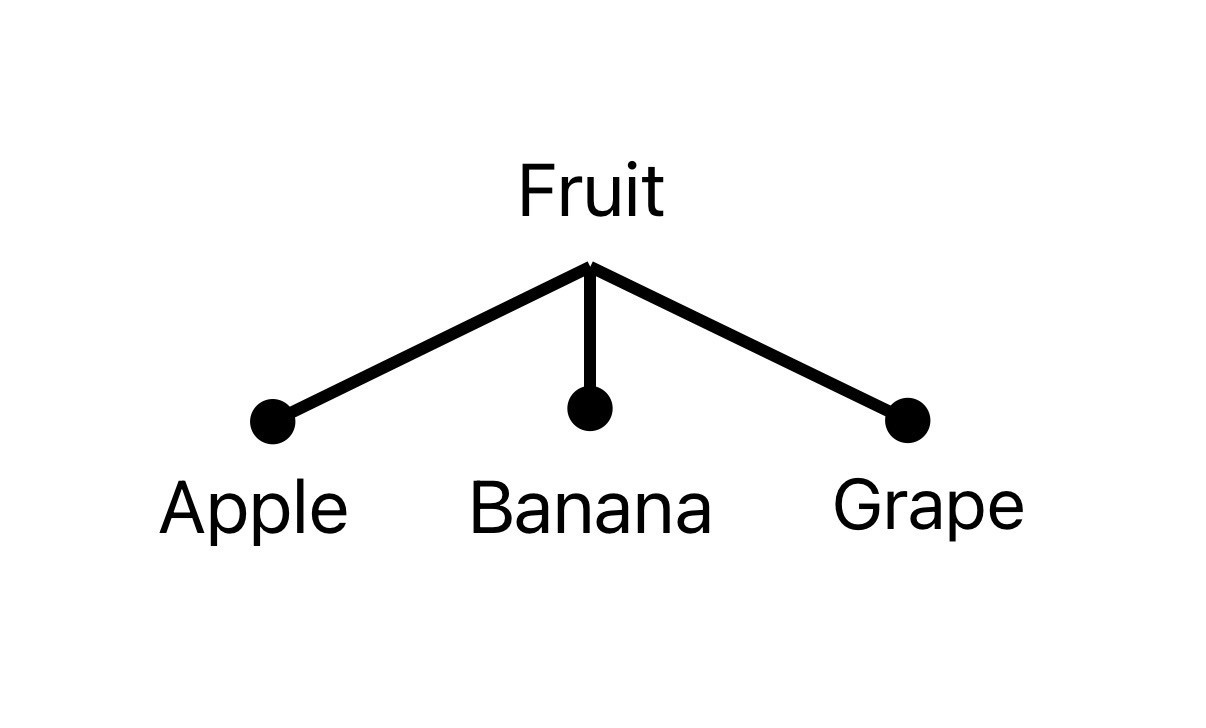
What this means
All three items sit on equal footing because they all share:
the same parent
the same rule
the same standard
This is what equality truly means in logic:
Equality is not sameness.
Equality is every element being evaluated by the same objective rule.
Their equality is not social or emotional, it is structural, arising from the objective parent node.
Now introduce:
carrot
Carrot does not satisfy the rule “fruit.”
Thus, in graph form, it cannot connect to the same parent node:
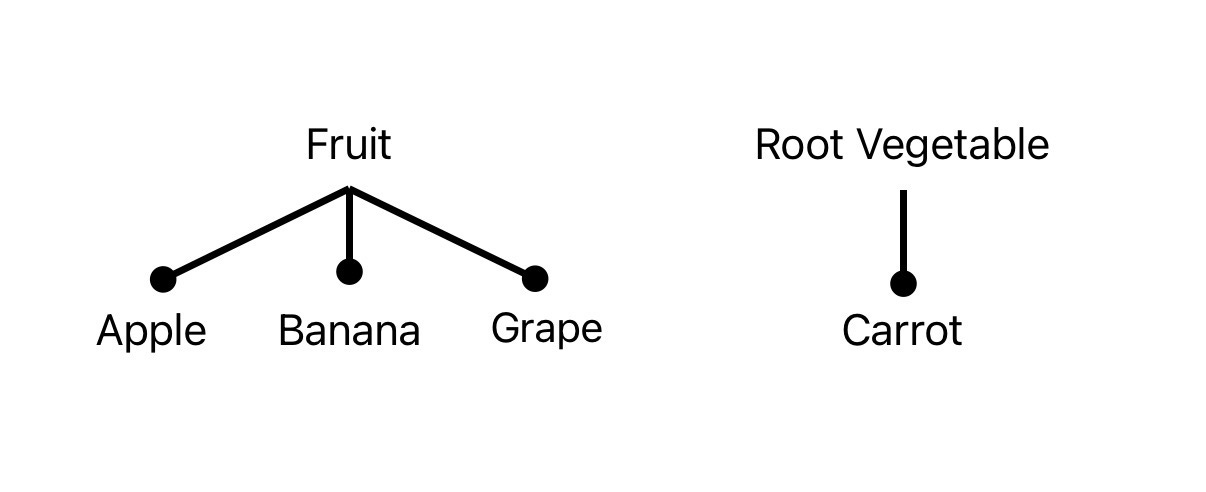
We now have two separate domains of coherence:
A fruit-coherence domain
A root-vegetable-coherence domain
Why this matters
Two things become immediately clear:
Carrot cannot be forced into the fruit graph without breaking coherence.
You would either need to:change the definition of fruit, or
add arbitrary edges that mean nothing
Either way, you destroy the graph’s objectivity.
Separate domains produce power dynamics.
When two incompatible standards exist,
the only way to combine them without an external rule is force.
This is exactly what happens in human systems:
If two people operate under different standards,
and no objective standard exists,
the stronger standard absorbs the weaker; not by truth, but by power.
Graph theory exposes this brutally:
Where there is no shared objective parent node, power becomes the arbiter.
Coherence dies, and force fills the vacuum.
If instead we step back and recognize that all four items fall under a broader, more universal external rule:
edible vegetation
…then we get a new, more coherent graph:
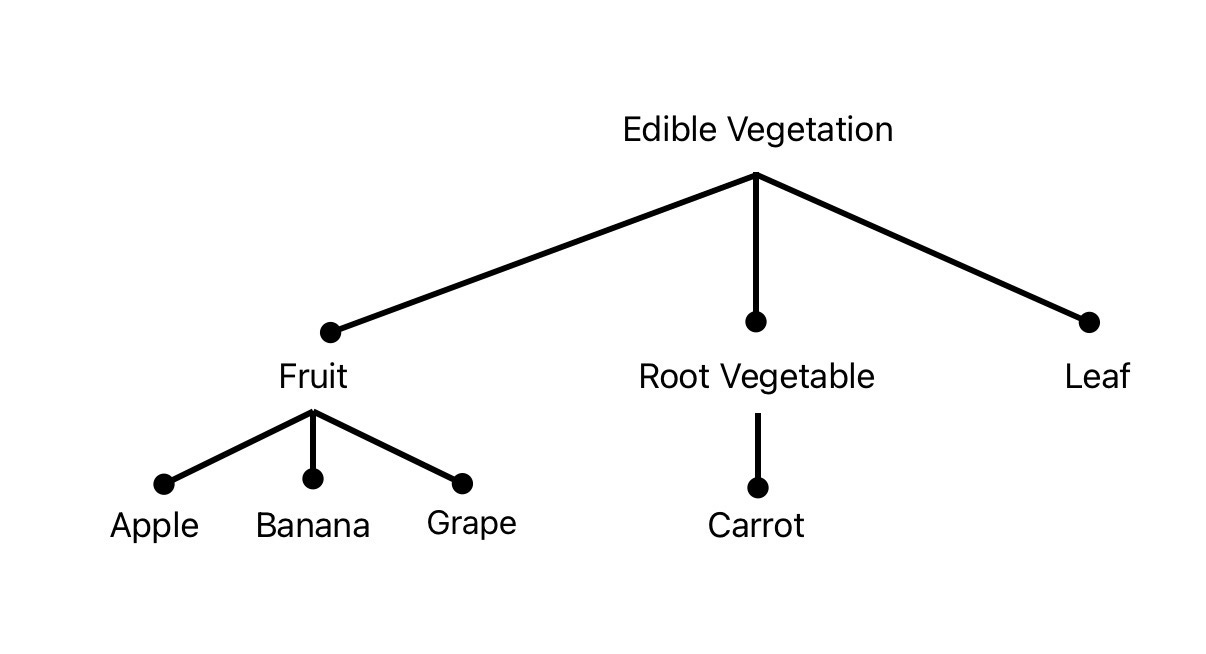
Now every item connects to the same ultimate parent node, meaning:
Coherence is restored
Equality is restored
All contradictions dissolve
No domain requires force to dominate another
The system regains a single, stable, objective structure
The deeper point
This is mathematically profound:
Expanding the external reference point does not weaken objectivity.
It strengthens it by making the rule more universal while remaining singular, external, and invariant.
The refined parent node does not arise from the elements themselves;
it arises from a larger truth outside the graph.
This illustrates how human understanding grows:
When contradictions appear
We re-evaluate the parent node
But the new parent must still be:
singular
external
independent
universal (to the entire set)
invariant
non-derivative
Otherwise the graph simply collapses again.
What this teaches us
This visualization shows something essential about objectivity:
Equality requires the same parent node.
Without that, “equality” is empty rhetoric.Separate parent nodes create separate domains.
And domains with different standards cannot unify except through power.Objectivity is the only protection against power.
Without a shared external standard, the powerful define coherence.Reconciling contradictions requires expanding the parent node, not bending it.
This prepares the ground for Gödel’s section:
When a structure collapses internally
Only an external, higher-level rule restores coherence
A system cannot fix its own inconsistency from inside itself
Graph theory makes Gödel’s insight visible.
GÖDEL’S THEOREMS
Gödel’s incompleteness theorems apply across formal logic, computation, cryptography, proof systems, and AI.
Gödel showed that no system can fully validate itself from within; there will always be truth the system cannot prove using only its own internal rules.
Let’s apply this to our single example:
Our set S or graph G cannot define the objective criteria that govern it.
The set cannot justify why “edible vegetation” is the right criterion.
The graph cannot explain why certain connections are valid.
The system cannot ground its own coherence.
If we try to let the system self-justify, contradictions reappear:
Carrot is a fruit because the system says so.
So the system is correct.
Therefore carrot is fruit.
This is circular self-reference—Gödel’s forbidden loop.
Coherence collapses because the criteria are internal rather than external.
Once again, repair requires the same move:
Introduce an objective reference point: a biological or agricultural classification independent of the system.
With that external criterion:
Circularity collapses.
Contradiction dissolves.
Coherence is restored.
Set theory, graph theory, and Gödel’s logic all converge on one fact:
Objectivity requires an external, singular reference point.
Nothing inside the system can replace it.
Everyday Life
This is not merely a matter of math. Consider the meter versus the yard as a concrete analogy for objectivity and reliability in measurement. The modern meter is defined by a universal physical constant: it is the length of the path travelled by light in vacuum in 1/299,792,458 of a second, a definition tied to the invariant behavior of light and atomic time standards. The yard, by contrast, has origins in historically contingent standards (folk or royal measures) and was standardized later in reference to the meter; it reflects a local authority that once tied length to a king’s body or to variable artifacts. The meter’s definition is anchored to constants of physics and international agreement; the yard’s origin is anchored to contingent human authority. Where the domain of measurement is ‘length as measured against electromagnetic invariants’, the meter is objectively superior because it ties the domain to a neutral external anchor (light/time), not to a local ruler. That is the practical lesson: units grounded in universal, independent constants provide cross-domain coherence, whereas units grounded in contingent, internal standards are fragile and parochial.
The meter/yard example scales as an intelligible metaphor for ontology. If your measuring standard (the yard) is derived from the whim or body of a ruler inside society, your entire system of law, engineering, and trust is contingent on that ruler and on the social arrangements that protect the ruler’s authority. If your standard is tied to an invariant outside human caprice (the speed of light, atomic transitions), then measurement is portable, verifiable, and not subject to political whims. At the maximal level, the set of everything that exists, this difference matters enormously.
Let’s review one more example. Imagine two pilots approaching the same runway.
Pilot A uses feet for altitude.
Pilot B decides he prefers “personal altitude units” because he doesn’t like imposed standards.
If objectivity were optional:
They could not coordinate.
Air traffic control could not prevent collisions.
Thousands of lives hinge on one invariant external standard.
Altitude works because:
it is singular,
external to any pilot’s preferences,
universally applied,
independent of opinion,
invariant,
non-derivative.
Remove any one of these, and the sky becomes brute-force chaos; not merely disorganized but violently unsafe.
This is what happens to societies when moral or epistemic objectivity collapses:
we drift from coordination to collision.
This is why objectivity is not just theory, it is the only protection from arbitrary power. When the anchor is hidden, the consequences are predictable and brutal. Without a neutral external reference, logic becomes negotiable; truth becomes what the most powerful can enforce or narrate. Power substitutes for reason; force becomes the substitute for law; manufactured consensus substitutes for universal principle. History is full of the outcomes: war, genocide, structural injustice, socially engineered hierarchies that hide behind rhetoric while violating the structural conditions of objectivity. Those who can reason at later principles, who can calculate, organize, and manipulate, but who cannot or will not reason at first principles, can maintain stable dominance by occluding the parent node from public discourse.
If every subset of reality—mathematics, aviation, measurement, biology—requires an external reference point to maintain coherence, then the entire universe, the total set of all sets, must also have an objective reference point outside itself.
Because the universe cannot:
justify its own laws from within,
ground logic from within,
explain existence from within,
supply necessary being from within.
Just as Gödel showed for formal systems,
the comprehensive set (the universe) requires an external singular reference point to be logically possible.
This leads directly to ontology:
The universe’s coherence requires a transcendent, singular, external, independent, invariant, non-derivative reference point.
That reference point is not “inside” the universe the way a constant is inside an equation. At the level of ontology, the only way to measure being, or to ground rights and justice transparently, is to tie evaluations to a principle that is not part of the contingent reality, that which is limited to empirical observation, because any foundation inside this domain will be manipulable by power.
It stands beyond the universe the way objectivity logically stands beyond a set.
That reference point is God.
Not a sky-being.
Not an internal force.
Not a mythic agent.
But the necessary reality that powers:
logic,
intelligibility,
existence,
the distinction between true and false,
the possibility of objectivity at all.
God is the external evaluator that gives the universe coherence, the way the meter standard gives physical measurement coherence.
Without this transcendent anchor:
logic collapses into relativism,
morality collapses into force,
rights collapse into opinion,
existence collapses into absurdity.
God is the precondition for logic and intelligence to be possible.
God stands beyond temporal reality, grounding it. And because objectivity is always accessible through reason, God is always accessible through objective reasoning.
The universe is powered—electrified—by this transcendent objectivity.
And that is what makes truth real.
I appreciate your article. Does Kant's categorical imperative come into play for Godel?