


Objectivity is the condition that makes understanding possible at all. In everyday terms, objectivity simply means that something is what it is regardless of who is observing it, preferring it, or interpreting it. A temperature does not change because someone dislikes it. A measurement does not shift because a group votes differently. A logical conclusion does not become false because it is inconvenient. Objectivity is what allows people to disagree meaningfully, to correct errors, to test claims, and to distinguish between what is real and what is imagined. Without objectivity, communication collapses into preference, power, or noise.
This is why objectivity quietly underlies science, reason, common sense, and justice. Science assumes that nature behaves consistently whether or not we are watching. Reason assumes that conclusions follow from premises independently of desire. Sense perception assumes that there is something stable being perceived. Justice assumes that a wrong remains a wrong even when committed by the powerful. None of these work if reality itself is negotiable. They all presuppose that there is a structure to truth that does not originate in human will.
In everyday life, we rely on objectivity constantly without naming it. When builders use a level, they are not appealing to opinion. When pilots rely on instruments, they are not consulting narratives. When two people argue about whether a bill was paid, they check a record that stands independent of either of them. Objectivity is what allows disputes to be resolved rather than endlessly asserted. It is what allows error to exist as a category at all.
For objectivity to function, however, it must satisfy specific structural criteria. These are not cultural preferences; they are logical necessities. An objective standard must be singular, external to what it evaluates, independent of the elements within the system, universal in its application, and non-contradictory in its operation. If any one of these fails, objectivity collapses.
Singularity matters because if there are multiple ultimate standards, conflict cannot be resolved without appealing to power. If two rulers both claim to be the true length of a meter, measurement becomes arbitrary. Zero standards fares no better: without any reference point at all, comparison is impossible. Only a single, non-competing reference can ground coherence.
Externality matters because a standard cannot be evaluated by what it evaluates. Independence matters because if the standard depends on the things it measures, it shifts when they shift. Universality matters because a standard that applies only sometimes is not a standard at all. Non-contradiction matters because a system that affirms and denies the same thing destroys meaning.
These criteria are not philosophical inventions; they appear naturally when we examine how formal systems work. This is where set theory and graph theory enter, not as abstractions, but as tools already embedded in everyday life.
Set theory begins with a simple idea: a set is a collection of elements. A set can describe relationships among its members, but it cannot define itself from within. In mathematics, sets are used everywhere: databases, classification systems, probability models, software types, inventory systems, and scientific taxonomies all rely on sets. When an online store tracks products, it uses sets. When epidemiologists track populations, they use sets. When programmers define what inputs are allowed, they define sets.
Here is a simple structural example.
Let S be the set {red, blue, green}.
We can describe properties of S: all elements are colors; each occupies a position within the visible spectrum.
But no element inside S defines what a “color” is, nor what makes something a member of the spectrum.
The rule that determines membership—having a wavelength within a specific range of electromagnetic radiation—does not belong to the set itself. Red does not define “color,” blue does not ground the spectrum, and green does not explain why they belong together.
If we attempted to define the category by appealing to one of its members—say, “red is the standard”—we immediately face the same problem: why red rather than blue or green? Any such choice is arbitrary unless justified by a rule outside the set.
And the moment justification is required, the supposed standard has already failed to be objective.
The principle is simple: a governing condition cannot be a member of the domain it governs. When it is, coherence collapses into circularity.
Graph theory, or node theory, makes this even more intuitive. A graph consists of nodes connected by edges. Graphs are used constantly in real life: transportation networks, electrical grids, social networks, internet routing, supply chains, neural networks, and recommendation algorithms are all graphs. Their usefulness depends on structure. Meaning emerges from relationships, not isolated points.
In a graph, no node has meaning in isolation. A node’s identity is defined by its connections. But here is the crucial insight: the network as a whole still requires an external frame of reference to be evaluated. No node can ground the entire graph, because each node depends on the graph for its identity.
Consider a simple graph with nodes A, B, and C.
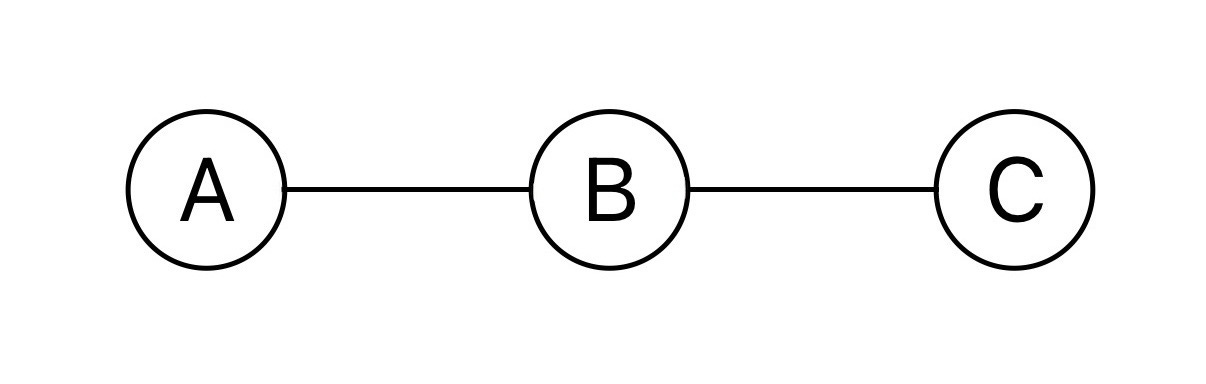
If we ask, “Which node determines the structure of the network?” the answer is none of them individually. If we pick A, we must justify why A is privileged. That justification cannot come from the graph itself without circularity. Once again, the grounding reference must lie outside the network.
This is not a metaphorical limitation; it is structural. Graphs can describe internal relationships, flows, and patterns, but they cannot supply an ultimate reference point from within. Any attempt to do so collapses into relative positioning rather than objective grounding.
Gödel’s incompleteness theorems formalize this limitation with mathematical precision. Gödel proved that any sufficiently powerful formal system cannot be both complete and consistent using only its own axioms. In plain terms, no system can fully account for itself from inside itself without leaving truths undecidable or introducing contradiction.
Gödel’s result is not an attack on reason; it is a description of its boundary. It tells us that logic does not float freely. It must be grounded. A system needs axioms it does not generate. Those axioms are not proven by the system; they make the system possible.
This directly mirrors the criteria of objectivity. If a system tries to ground its own objectivity internally, it either becomes inconsistent or incomplete. Logic breaks not because logic is weak, but because objectivity has been violated. The standard has been placed inside the set.
To make this concrete, consider a simple arithmetic system. We accept axioms like “0 ≠ 1” and “if equals are added to equals, the sums are equal.” These are not proven inside arithmetic; they are assumed. If we attempted to vote on them, negotiate them, or derive them from arithmetic itself, arithmetic would stop working. The system functions because its grounding is external, singular, and non-negotiable.
This same structure appears in measurement. The yard was historically defined by the length of a king’s arm. That made it contingent on a person; an element inside the social set. As kings changed, so did the yard. The meter, by contrast, is defined by a constant of nature: the distance light travels in a vacuum during a specific fraction of a second. That reference does not belong to any culture, body, or era. It is external, singular, universal, and invariant. That is why the meter is more objective. It is not more precise because humans are smarter; it is more precise because its reference is not inside the system it measures.
Now consider what happens when objectivity fails. If there is no singular standard, disputes cannot be resolved except by force. If there are multiple competing standards, power decides which one dominates. If there is no external reference, coherence dissolves into narrative. Brute force becomes the only remaining arbiter—not because people are evil, but because structure is gone.
This is why science collapses without objectivity. Experiments presuppose that results are not created by belief or opinion. This is why reason collapses without objectivity. Arguments presuppose that conclusions follow regardless of preference. This is why justice collapses without objectivity. Rights presuppose that a human being has worth prior to recognition, law, or consensus.
At this point, objectivity has been fully normalized. It is no longer abstract. It is how we measure, reason, build, and judge. The final step is scale.
Every set we have discussed so far—numbers, networks, societies—exists within a larger context. The most comprehensive set possible is the universe: the total set of all that exists. If objectivity is required for coherence in any set, then the universe itself, to be coherent, must satisfy the same criteria.
The universe cannot ground its own objectivity internally. If it did, it would be explaining itself with itself. That violates the same constraints revealed by set theory, graph theory, and Gödel. The objective standard that makes the universe intelligible cannot be one of its elements. It must be singular, external to the total set, independent of it, universal across it, and non-contradictory.
At this scale, the conclusion is unavoidable. If reason, science, sense, and justice are possible, then objectivity must exist. If objectivity exists, it must be grounded in a singular, external, independent, universal source. That source cannot be the universe itself. It must be what gives the universe coherence.
Anything that exists is able to orient—physically, logically, morally—only because it coheres objectively within its existential capacity. Laws of nature hold. Logic applies. Causes precede effects. Persons reason. None of this is possible in a reality without objective grounding.
This has direct and unavoidable consequences for justice and rights. If human rights are inherent, they must be grounded objectively. If there is no objective ground, then rights are not inherent at all; they are permissions granted by authority and revoked by force. Any document that claims universal human rights while denying an objective foundation is incoherent. It is making a claim that its own metaphysics forbids.
There is no neutral middle position here. If there is no objective ground external to reality, then science is not knowledge but habit, reason is not truth-tracking but preference, justice is not justice but enforcement, and universal human rights are a hoax—an empty assertion dressed in moral language with no structural support.
Conversely, if science works, if reason binds, if justice is more than power, then objectivity is real. If objectivity is real, it requires a singular, external, independent ground. That ground cannot be the universe itself. It is what gives the universe coherence.
Deny that, and everything built on reason collapses into contradiction. Affirm it, and coherence is not imposed on reality—it is recognized and human rights can be fully reasoned with scientific accuracy, not frivolity.