


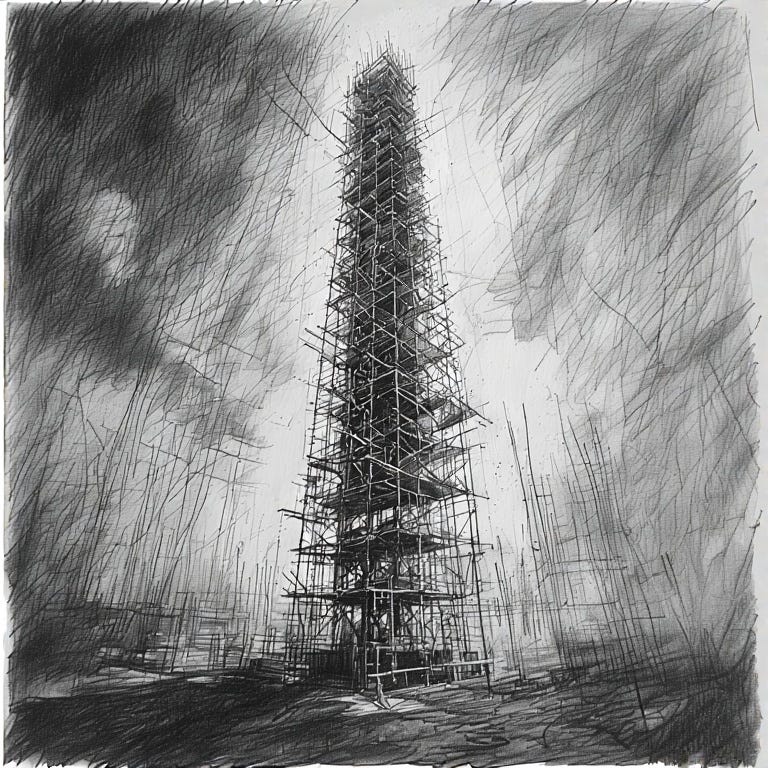
In modern discourse, the word “God” has become a caricature—either a symbol of outdated mythology or a cosmic figure imagined far outside the boundaries of the universe. This version is typically externalized: a superbeing hovering beyond the clouds, imagined like a divine monarch issuing laws from above. As a result, most contemporary conversations about God are limited to belief, disbelief, or indifference—treating the idea as optional, perhaps culturally significant, but ultimately irrelevant to reason, science, or reality itself.
But this reduction misses something essential. It overlooks a deeper, older view: not of God as a being within reality, but as the very ground that makes reality possible in the first place. In this view, “God” is not a hypothesis. He is not one item among many. Rather, this concept points to the necessary precondition for existence, coherence, and objectivity. Not something “out there” to be discovered, but the very reference point without which there could be no “out there” to speak of.
To see this, one must not begin by looking outward, scanning the stars or analyzing scripture. One must start by simply acknowledging this: we exist. But our existence is not self-originating. We are contingent beings—we came into existence, we change, we depend on conditions outside ourselves. And this fact of contingency is not limited to humans. Everything we observe in the universe is similarly dependent—on causes, on prior states, on systems, laws, energy, structure.
So the question arises: if everything is contingent, how is there anything at all?
The rational mind is compelled to recognize that this chain of dependency cannot extend infinitely without grounding. There must be a foundation—not itself dependent—upon which all contingent things rely. This necessary reality must exist by its very nature, and it must be the reference point that allows everything else to be.
This is not a religious claim. It is a logical necessity. And throughout history, this foundation has been what the concept of God originally pointed toward: not a being within the universe, but the reason there is a universe at all. The source of coherence, not a character within the chaos.
This recognition is what opened the gates to reason itself.
Why? Because once there is an ultimate reference point—unchanging, necessary, not subject to opinion or desire—then objectivity becomes possible. Truth can be pursued because there is something real to be true about. Logic can be trusted because it is grounded in something deeper than human preference. Morality can be coherent because it is anchored in the structure of being, not just cultural invention.
This was the philosophical shift that made the Enlightenment possible. Not the abandonment of foundations, but the re-centering of thought upon them. Thinkers began to strip away superstition not by rejecting the idea of a necessary ground, but by clarifying it—by separating it from anthropomorphic myths and political control. In doing so, they uncovered a framework of reality that allowed human reason to flourish.
Objectivity—so vital to science, ethics, law, and logic—depends entirely on the existence of a stable, transcendent reference. And while we apply objective standards every day in measurement, communication, and technology, we often forget that objectivity itself needs grounding. You cannot measure a ruler by itself. You cannot derive constants from chaos. There must be something fixed that gives meaning to the fluid.
The tragedy of modernity is that we inherited the fruits of this foundation—reason, rights, rational inquiry—while denying the root from which they grew. We kept the objectivity, but discarded the objective reference. We applied the framework of coherence to every domain except the one that matters most: the foundation of existence itself.
To recover that foundation is not to regress into dogma. It is to move forward with integrity. It is to recognize that the pursuit of truth, if it is to mean anything at all, must begin at the level of being—not just at the edges of what we can observe, but at the source that makes observation and meaning possible.
God, rightly understood, is not the conclusion of a debate. He is the precondition for the debate to occur.
Yes absolutely ! And very similar to Ibn Sina , necessary being philosophy! Love this article . Thank you for sharing