


Objectivity is one of modern day’s most cherished ideals. It underpins science, mathematics, justice, and the very possibility of fairness. Without it, there can be no shared reality, only a power struggle between competing narratives. When we speak of objectivity, we usually mean something stable and external: a standard that exists beyond personal bias, one we must conform ourselves to if we want to be just, truthful, or free.
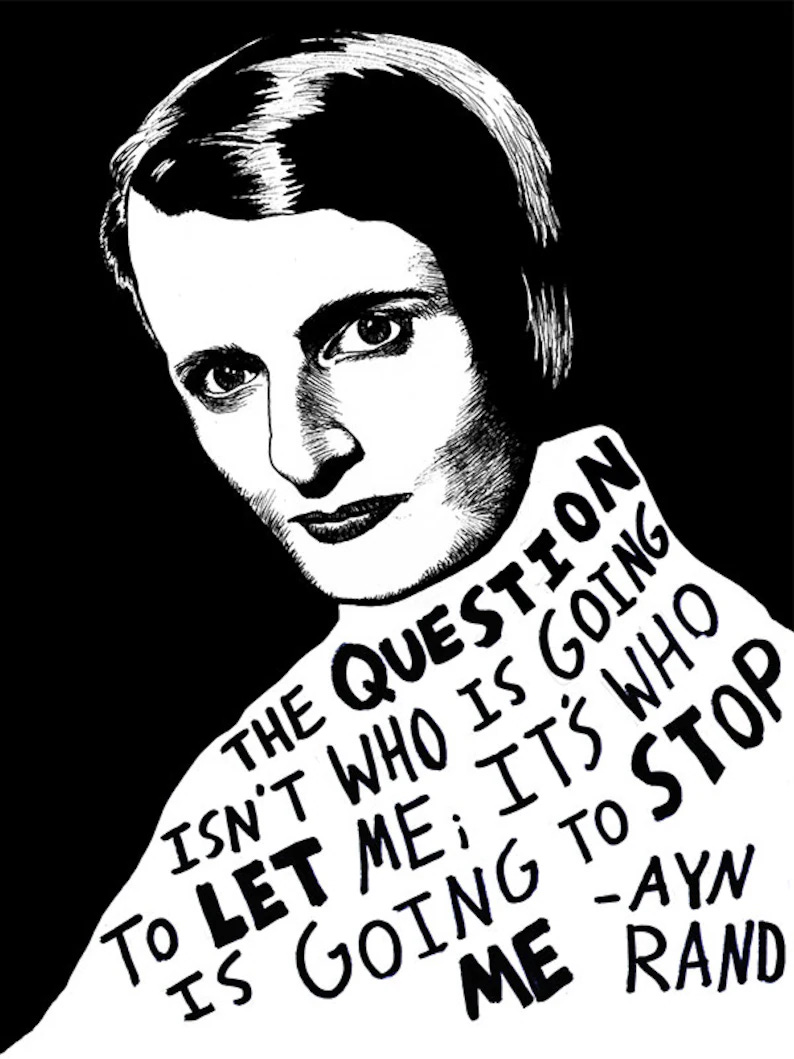
But somewhere along the way, a philosophical bait-and-switch occurred. As the connection between objectivity and a transcendent reference point faded from cultural memory, religion was increasingly dismissed as superstition. Into that void stepped a new ideology—Objectivism, most famously articulated by Ayn Rand. It claimed to champion reason, clarity, and individual freedom. But beneath the surface lies a contradiction: it wears the mask of objectivity while making the self the highest authority.
At first glance, Objectivism appears noble. It rejects collectivism, emotionalism, and blind faith. It calls for rational thinking and personal responsibility. But these virtues, when severed from a higher grounding, become tools of self-worship. Objectivism tells us that truth is real, but then defines reason as the sovereign domain of the individual. In other words, the individual is not just responsible for their own thoughts; they become the arbiter of reality itself.
This is not objectivity. It is the exaltation of the self wrapped in the language of logic.
True objectivity demands submission. It means that reality is not something we create, but something we discover. It is not something that we define, but something that defines our ability to exist. It is not crafted by consensus, popularity, or preference. It exists whether we like it or not. To be objective is to acknowledge that we are not the source of truth, but its recipients. It requires humility before something higher than ourselves—something permanent, fixed, and independent of human will.
This is why belief in God, rightly understood, is not at odds with reason; it is what makes reason coherent in the first place. Not a mascot among the clouds, but the keystone upon which reality depends. Remove the keystone, and the entire structure collapses. Every concept we lean on—truth, justice, freedom, dignity—begins to fracture the moment we treat God as optional. Without a necessary, unchanging constant for being and value, objectivity becomes a floating abstraction; something we claim but no longer understand.
God is not merely a religious belief but the ontological foundation of existence itself. To “believe in God” is to recognize that existence is not ours to define or dominate, but a gift we share with every other being. And that recognition becomes the only rational basis for protecting the dignity of others, including those we dislike or disagree with.
Objectivism, on the other hand, removes the Axiom but wants to keep the fruit of its presence: logic, clarity, rights, and freedom. It wants objectivity without acknowledgement. But once you sever truth from its source, it slowly morphs into something else—self-justification. The self becomes the ultimate reference point, and others are judged by how well they conform to your vision of rationality or strength.
This explains how a philosophy that claims to protect human freedom can so easily justify cruelty. If rights are no longer grounded in an existentially unbiased source but instead in the individual's capacity to reason or produce, then those who fall short—whether the weak, the poor, the disabled, or the inconvenient—can be quietly erased from moral concern. The dignity of others becomes conditional. And when dignity is conditional, it is always negotiable.
True objectivity does the opposite. It levels the playing field. It says: if something exists, it matters; not because I like it, not because it serves me, but because it was given existence by something higher than us both. Objectivity rooted in God defends even your enemy’s right to exist, not out of sympathy, but out of principle. Because existence is sacred; not for how it feels, but for what it reveals: that none of us are the source of being.
When Ayn Rand’s protagonist in Anthem declares, “I am God,” it is not a bold affirmation of liberty, but a chilling declaration of supremacy. It reveals the true flaw of Objectivism: it takes the structure of objective reason, a gift resting on solid ground, and uses it to crown the self. It pretends to uphold truth while denying the source of truth. It throws away the ladder it used to climb, and then insists it still stands on solid ground.
This is not just philosophical error—it is dangerous. Because when truth no longer humbles us, it begins to serve us. And when truth serves us, so does morality, justice, and the right to exist.
To reclaim objectivity, we must recover its source. We must recognize that God is not a myth to be debated, but the necessary reference point that makes reality coherent, dignity stable, and freedom just. Without God—the keystone—the structure of truth and meaning collapses into preference and power.
And when truth becomes preference, freedom becomes a tool of dominance, not protection.
True objectivity, grounded in the Axiom, God, the necessary reality, etc., doesn’t just guarantee freedom when we agree—it enforces it when we don’t. That is the only kind of freedom worth defending.
Hi,
You had written:
“But these virtues, when severed from a higher grounding, become tools of self-worship. Objectivism tells us that truth is real, but then defines reason as the sovereign domain of the individual. In other words, the individual is not just responsible for their own thoughts; they become the arbiter of reality itself.”
I’m not an objectivist, but I believe this is a misrepresentation of that philosophy. Reason doesn’t become the arbiter of reality itself, but the means to correctly conceptually identify it and understand its nature.
I’d be interested in hearing your thoughts on this distinction.
—James Caputo