


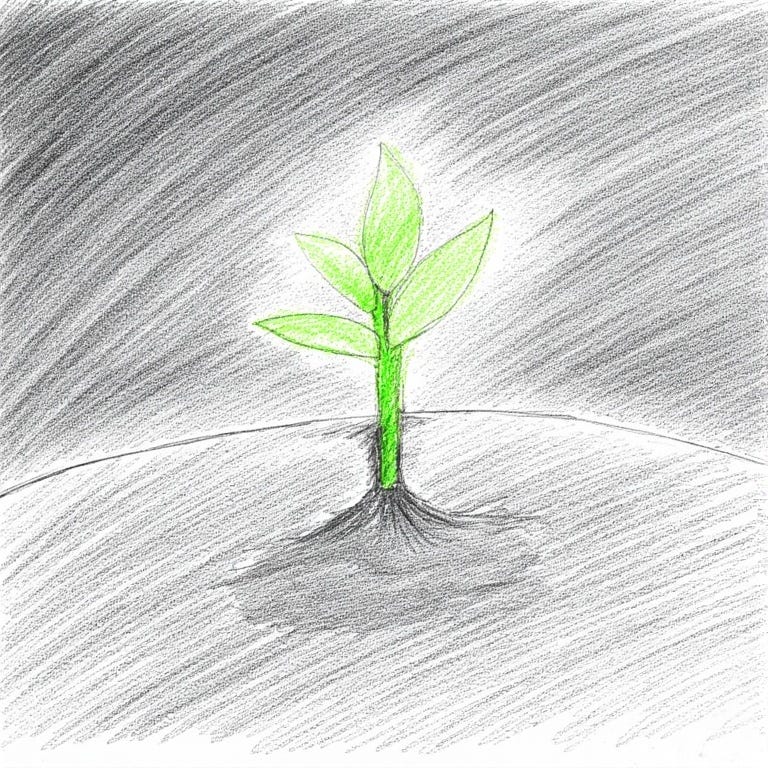
Hope is often spoken of as a feeling, a spark that helps people carry on through hardship. But beneath that sentiment lies something much deeper. Hope is the lived recognition that coherence exists, that reality itself leans toward order, not chaos. Even when all else collapses, the structure of being still points upward. That bias toward coherence is the quiet reason why sense can always be found again.
Coherence is what allows things to make sense in the first place. Sense requires structure; a ladder that leaves a trail, a sequence that can be retraced. Even when someone falls into confusion, the fact that confusion can be recognized means coherence still surrounds it. There is no such thing as absolute nothing, only an empty container waiting to be filled with structure once more. This is why, even in the darkest circumstances, the possibility of clarity never disappears. The ladder is always there.
Hope, then, is not naive optimism. It is the logical response to a reality that always permits re-alignment. When a person tries to step outside the frame to view their situation objectively, however slightly, coherence begins to mirror that effort. The smallest reach toward objectivity invites an equal response. This is why real hope is not passive; it is a disciplined trust in the framework that makes understanding possible.
But the story of hope has been rewritten in modern times. Instead of being seen as a path toward coherence, it has been sentimentalized into comfort, an emotion to hold instead of a structure to climb. This softens its meaning. Institutions, media, and even well-intentioned movements often use hope to pacify rather than awaken. They tell people to “believe things will get better” without ever showing how or why. This turns hope from a tool of action into a cushion of delay. It asks people to stay inside the frame and wait, instead of stepping out and seeing the wider structure that makes restoration possible.
This form of psychological misuse plays on a simple truth: people long for reassurance more than responsibility. False hope meets that longing by offering warmth without coherence, feeling without orientation. It turns the abstract discipline of stepping out, of seeking objectivity, into an emotional product. And the more comforting that product becomes, the less incentive anyone has to seek the real framework that sustains meaning.
Societal misuse works the same way. Political slogans, corporate messaging, and cultural narratives often trade on hope while subtly detaching it from truth. They encourage trust without verification, faith in progress without clarity of direction. This is not the language of coherence, it is the language of sedation. Hope becomes a tool of control when it tells people to stay where they are instead of seek what is real. It dulls the awareness that coherence must always be actively tested to orient against, not just assumed.
This distortion of hope is dangerous because it blurs the difference between movement and progress. People feel inspired, even mobilized, but without reference to something objective, the motion goes nowhere. It loops inside the frame, producing exhaustion instead of clarity. Lies thrive in this environment because the sentiment of hope replaces the structure of reason. The world begins to celebrate the feeling of “trying” more than the discipline of understanding.
But real hope is different. Real hope is an act of perception. It comes from recognizing that reality itself is coherent, that existence never stops offering the chance to reorient. This kind of hope cannot be given or sold; it has to be practiced. It demands awareness of objectivity, the courage to step outside, and the humility to rebuild on what is real.
Hope is not the opposite of realism. It is realism at its deepest level, the certainty that coherence is the most constant feature of existence, and that every sincere step toward it will always be met by light. When people remember this, hope becomes more than comfort; it becomes strength. It becomes the quiet logic through which the world continually finds its way back to truth.