


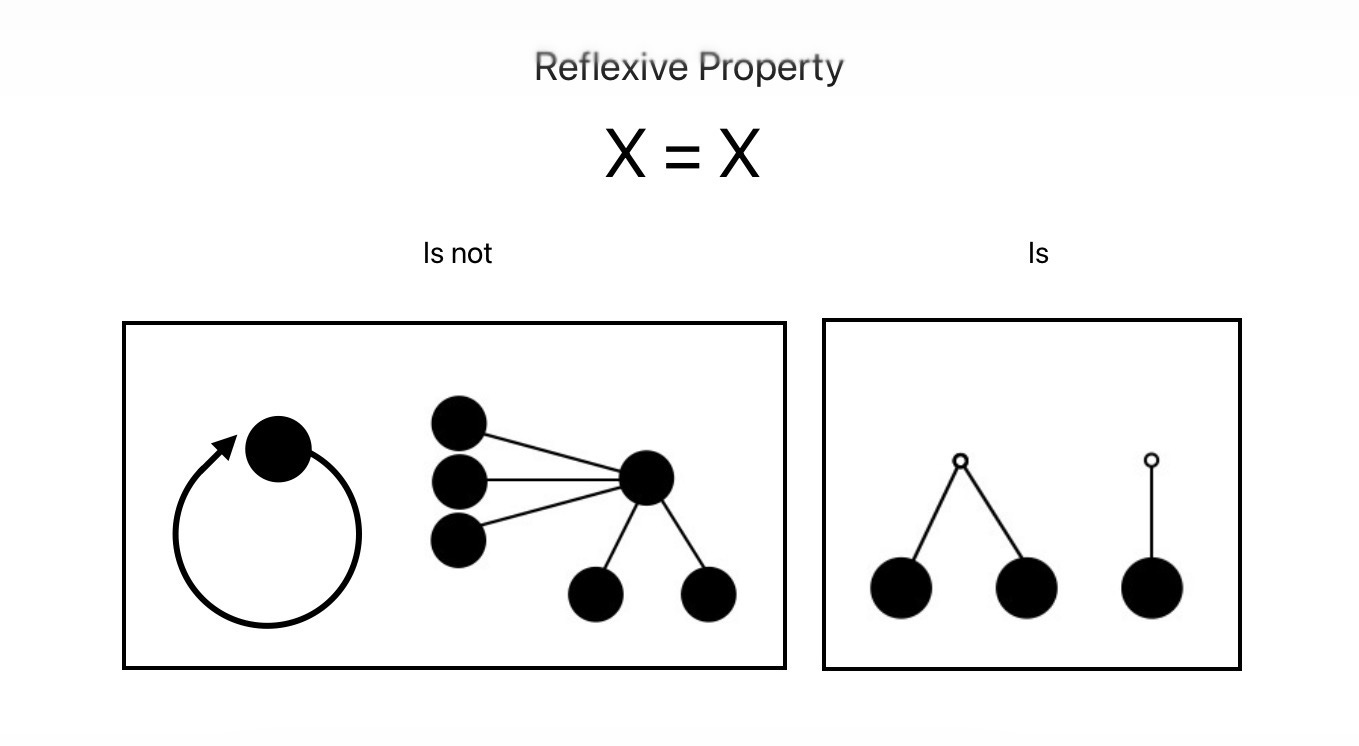
You are you. It is difficult to imagine a statement more obvious. In mathematics, the basic principle can be expressed simply:
x = x
A thing is identical to itself. There is nothing controversial about this. A person is himself. A person is not somebody else. Identity is reflexive at the surface. The problem is that it is so subtle that we begin asking this simple property of identity to do far more work than it can actually do.
We take “I am me” and quietly turned it into “I define me.” Those are not the same statement. The first is a statement about identity. The second is a statement about authority. And the difference between them has tremendous implications for how we understand self-identity, self-worth, conflict, and even our ability to change as a civilization.
Modern and contemporary discourse frequently treats the individual as the primary authority over his own identity. We are constantly bombarded with phrases such as “be yourself,” “define yourself,” “love yourself,” “know your worth,” and “be authentic.”
There is something deeply valuable in these ideas. A person should not have his worth determined arbitrarily by another person. He should not have to earn his right to exist through status, productivity, beauty, popularity, wealth, or social approval.
But there is a deeper problem hiding underneath much of this language. If the self is made the ultimate reference point for the definition of the self, then self-identity becomes reflexive:
x = x
The problem is that the reflexive property is not enough. Through this conflation, the self becomes something like:
x = whatever x says x is
The self becomes its own reference point. This appears to solve the problem of self-worth because nobody can take the authority to define the self away from the individual, but it creates another problem.
What happens when the individual’s understanding of himself is wrong? What happens when my perception of myself conflicts with your perception of me? What happens when the person I believe myself to be is contradicted by what I repeatedly do? What happens when I change? What happens when the person I was five years ago, the person I am today, and the person I hope to become cannot all be captured by the same self-description?
The reflexive property cannot answer these questions. It establishes that I am me. But leaving the reflexive property at that position turns identity into circular reasoning. It does not establish that I understand me correctly. That distinction is the beginning of an objective theory of the self.
Identity Is Not the Same as Self-Knowledge
The statement x=x is true regardless of whether anyone understands x. That is precisely what makes reflexive identity so useful. But it also reveals its limitation. If I say:
“I am generous.”
the fact that I am the person making the statement does not make the statement true. I may genuinely believe that I am generous. I may have memories of times when I sacrificed for other people. Someone else, however, may have experienced me as selfish. Perhaps both observations contain truth. Perhaps I am generous with my friends but selfish with my family. Perhaps I remember my sacrifices while forgetting the sacrifices others have made for me. Perhaps the other person is resentful and has interpreted my behavior unfairly.
The point is not that the other person’s perception must be correct. The point is that my perception does not become correct merely because it is mine. This is where self-identity becomes an ontological problem rather than merely a psychological one. The question is no longer:
“What do I feel myself to be?”
It becomes:
“What is the most coherent account of who I actually am?”
That question requires more than introspection. It requires evaluation.
We Are a Sea of Perspectives
A human being is encountered from countless perspectives. I experience myself from the inside. My parents experience me as their child. My children may experience me as their parent. My friends experience me as a friend. My coworkers experience me as a colleague. A stranger experiences me through a brief encounter. My younger self experienced me differently. My future self may understand me differently.
Each perspective reveals something. None necessarily reveals everything. We are therefore a kind of sea of perspectives. Every person carries a partial model of himself and partial models of everyone around him. And because those models are partial, human beings inevitably collide.
Someone says:
“That isn’t who I am.”
Someone else says:
“That’s exactly who you are.”
We instinctively want to know which person gets to decide. Modern individualism often answers:
“The individual gets to decide.”
Many collectivist and relational traditions answer differently. The self may be understood through family, community, social role, duty, tradition, or a larger whole in which the person participates. Some Eastern philosophies go further and question whether the autonomous, independently existing self is even the correct starting point for understanding human identity.
These perspectives can offer important correctives to radical individualism. They remind us that we do not exist in isolation. But there is a danger if the collective becomes the final reference point for the individual’s identity and worth. Then the equation changes from “I define myself” to “The collective defines me.” The individual says:
“This is who I am.”
The collective says:
“This is who you are.”
The two positions appear opposed. But structurally, they share something important.
Neither is necessarily objective.
One privileges the individual perspective. The other privileges the collective perspective. Both are perspectives.
The Missing Reference Point
This is the problem with reducing selfhood to either individualism or collectivism in an ontologically illiterate civilization. The question is not simply:
Who gets to define me?
The deeper question is:
Against what can any definition of me be evaluated?
If my own perspective is the final authority, I can mistake self-perception for truth. If society’s perspective is the final authority, society can mistake consensus for truth. If my family’s perspective is the final authority, my family can mistake familiarity for truth. If my culture’s perspective is the final authority, my culture can mistake tradition for truth.
A perspective can contain truth without being the reference point for truth. That distinction is essential. Objectivity requires a reference point that does not simply collapse back into one of the perspectives being evaluated.
The same six conditions that make a reference point objective apply here:
Singularity
Externality
Universality
Non-derivation
Invariance
Independence
An objective account of the self therefore cannot simply be whatever I say about myself. Nor can it simply be whatever everyone else says about me. It must be capable of evaluating both. That is what makes objective self-knowledge more comprehensive than either individual or collective self-definition.
The Modern Promise: “You Define Yourself”
Consider one of the most common ideas in contemporary culture:
“You define yourself.”
The appeal is obvious. Human beings have historically been classified by other people. Families, tribes, governments, religions, social classes, and institutions have all assigned identities to individuals. So the declaration of self-definition contains a legitimate rebellion:
You are not merely whatever other people say you are.
That is important. But notice the leap from:
“Other people cannot be the final authority over me,”
we move to:
“Therefore I am the final authority over myself.”
The first statement does not entail the second. But there is a third possibility, one that is not immediately obvious in a society that suffers from ontological illiteracy:
Neither my perspective nor another person’s perspective is the ultimate reference point.
This third position is harder because it denies everyone, including the self, automatic sovereignty over the truth. But this position is the most stable.
With this position, I do not have to surrender my self-understanding simply because someone disagrees with me. I also do not have to defend my self-understanding merely because it is mine. I can investigate it.
“You Are Enough”
Consider another familiar phrase:
“You are enough.”
This can mean something profound. It can mean:
Your right to exist does not depend upon your productivity.
Or:
Your worth does not disappear because you failed.
Or:
You do not need to become socially impressive before you deserve dignity.
Those are objective-sounding claims. They place a floor beneath human worth. But the statement becomes unstable if “enough” simply means:
“Whatever you currently believe about yourself is sufficient justification for yourself.”
Now the foundation becomes convoluted and is reflexive once again. The irony is that much of modern self-worth language implicitly depends upon objective worth while explicitly refusing to articulate an objective reference point for it. And it happens so quickly, oftentimes within a single sentence, that it is easy to overlook.
We say a person’s worth is inherent, but if that worth is simply whatever the person decides it is, it isn’t really inherent. It is assigned. And if the individual must continually assign his own worth, then the person remains vulnerable to the collapse of his own self-evaluation.
An objective conception of worth provides something much more durable:
Your worth does not depend upon your ability to successfully recognize, perform, or articulate your worth.
That means worth can survive ignorance. It can survive failure. It can survive humiliation. It can even survive a person’s temporary hatred of himself. And perhaps this is the most significant recognition, that the person does not have to successfully believe in his own value for that value to exist. The objective position does not rely on one’s belief, in one’s buy in, for it to be real. It remains real with or without one’s awareness. Belief is not the source of reality; it is a hypothesis about reality. Objectivity is the compass that keeps us from mistaking our uncertainty for a change in reality. Faith is what keeps us oriented toward that compass.
“Love Yourself”
The same problem appears in the language of self-love. “Love yourself” can be a healthy corrective to self-hatred. But what exactly is being loved?
If the self is whatever the individual currently believes himself to be, then self-love can become unconditional affirmation of the current self-conception.
But there is another possibility. Perhaps loving yourself means recognizing that you possess value even while recognizing that you need to change.
That distinction is enormous. Suppose I discover that I have been arrogant. A reflexive model can make this discovery threatening if:
My identity = my preferred self-description
then:
“I am arrogant”
attacks my identity. But if worth is objectively grounded, I can say:
“I have behaved arrogantly.”
The admission does not destroy me. My behavior can be wrong while my existence remains valuable. This makes genuine moral growth possible. Objective worth makes self-correction compatible with self-respect.
“Be Authentic”
Authenticity creates another revealing example. We are constantly encouraged to “be authentic,” and authenticity is valuable. But authenticity answers a particular question:
“Does my outward expression correspond to my inward experience?”
Objectivity asks another:
“Does my inward experience correspond to reality?”
These are different questions. I can authentically believe something false. I can authentically feel worthless. I can authentically feel superior. I can authentically believe that everyone hates me. The authenticity of the experience does not establish the truth of its interpretation. This is why:
authenticity ≠ truth
Authenticity concerns the integrity of a perspective. Objectivity concerns the relationship between that perspective and reality. Modern discourse often gets the first right while quietly treating it as though it guarantees the second.
It does not. Your feelings matter. Your perspective matters. Your internal experience matters. But none of those contextual facts make your perspective the final reference point for reality, the most comprehensive context.
Therapy and the Language of Self-Esteem
This distinction also helps explain something interesting about contemporary therapeutic language. Healthy psychological practice often encourages people to distinguish their value from their failures. That is a fundamentally important insight.
A person can fail without being a failure. A person can make a mistake without being a mistake. A person can be rejected without being inherently rejectable.
Notice what has happened. The therapeutic insight is already moving away from reflexive identity. It is saying:
self ≠ current evaluation of self
That is an important step toward objective self-worth. But the framework can become incomplete when the replacement foundation is simply:
“Therefore, decide for yourself that you are valuable.”
That still makes worth dependent upon the self’s own declaration. A stronger formulation would be:
Your worth does not depend upon your declaration of it.
This is why objective self-worth can provide a deeper foundation for many of the psychological insights modern society is already trying to express. The problem is not the desire to protect human dignity. The problem is grounding dignity in the wrong place.
Social Media and the Manufacture of the Self
Social media makes the problem especially visible. The modern individual is encouraged to construct a public identity. A profile becomes a miniature biography. A photograph becomes evidence. A political position becomes identity. A lifestyle becomes identity. A profession becomes identity. A taste becomes identity. A community becomes identity. The person gradually learns to ask:
“How am I being perceived?”
and then:
“How should I present myself so that I am perceived correctly?”
The self becomes a project, and because the project is constantly visible, it becomes constantly vulnerable.
Likes become confirmation. Disagreement becomes rejection. Criticism becomes an attack on identity. The individual becomes trapped between two authorities:
Who I say I am
and
Who everyone else says I am.
Neither is sufficient. The objective question is different:
What is true about me regardless of whether the audience applauds or rejects the performance?
That question is liberating because it makes the self less dependent on the crowd without making the self dependent upon its own self-narration.
The Collective Alternative
The answer cannot simply be to swing to the opposite extreme. Many cultures have understood that the isolated individual is an abstraction. A person is born into relationships. He has parents. He belongs to families. He inherits languages. He participates in communities. He occupies social roles. He receives traditions. He depends upon institutions. His identity is relational.
This is a genuine insight. The problem begins when relational identity becomes collective sovereignty. A community can say:
“This is who you are.”
And sometimes it may know something about the individual that he cannot see himself.
But a collective can also be mistaken. A society can normalize injustice. A family can misjudge a child. A culture can confuse tradition with truth. A majority can be wrong.
Consensus can stabilize an error just as easily as it can stabilize a truth. So collectivism can correct the blindness of radical individualism while introducing another form of blindness:
The individual is no longer the unquestioned author of his identity, but the collective becomes the unquestioned author instead.
The objective position refuses both forms of sovereignty. It says:
The individual is a perspective. The collective is a perspective. Reality is the reference point against which both must be evaluated.
The Self Is Reflexively Identical but Perspectivally Incomplete
There is an important distinction here. The fact that a person changes does not mean that the person ceases to be himself. I am still me when I am five. I am still me when I am twenty-five. I am still me when I am eighty.
The reflexive property remains true. But every description I make of myself is necessarily limited to some perspective, moment, or context. We might therefore say:
The self is reflexively identical but perspectivally incomplete.
I remain myself across time, but no single snapshot exhausts what I am.
This is why self-knowledge is not simply the act of looking inward and finding an answer. It is the process of bringing perspectives into coherence. My memory tells me something. My behavior tells me something. Other people’s experiences of me tell me something. My failures tell me something. My successes tell me something. My intentions tell me something. The consequences of my actions tell me something.
None of these should automatically become the entire definition of the self. But neither should any of them automatically be dismissed because they conflict with the story I prefer to tell about myself. The objective approach does something more difficult. It asks:
What account can accommodate the greatest amount of relevant truth without becoming incoherent?
Conflict Is a Collision of Models
This gives us a better way to understand interpersonal conflict. When two people argue about a person’s character, there are actually several models interacting. I have a model of myself. You have a model of me. I have a model of you. You have a model of yourself.
When we disagree, those models collide. Suppose I say:
“I’m a generous person.”
You say:
“You’re selfish.”
The reflexive framework encourages me to protect my definition:
“You don’t get to define me.”
The collective framework might encourage me to submit to the dominant interpretation:
“If everyone thinks I’m selfish, maybe that’s who I am.”
The objective framework asks neither person to surrender. Instead:
What would the complete evidence suggest?
Perhaps I am generous in some contexts and selfish in others. Perhaps you observed behavior I failed to recognize. Perhaps you misunderstood my motives. Perhaps both of us are selecting evidence that confirms our existing models.
Now the disagreement becomes an investigation rather than a battle. The objective reference point doesn’t eliminate disagreement. It makes disagreement reconcilable.
From Brute Force to Tenacity
This distinction changes the kind of strength we want from a person. When there is no recognized reference point beyond competing perspectives, disagreement tends to become a contest of force. The individual says:
“This is who I am.”
The other person says:
“No, this is who you are.”
The individual responds:
“You cannot define me.”
The other responds:
“Everyone sees you this way.”
The argument becomes a struggle over authority. Who has the right to define reality, to define what is ultimately real? If neither individual nor collective perspective is treated as the ultimate reference point, the conflict can take another form. We can ask:
“What would make both of us revise our understanding?”
That question introduces tenacity rather than rigidity. Tenacity says:
“I will not surrender what is true simply because you disagree.”
But it also says:
“I will not defend what is false merely because it is part of my self-conception.”
That is a far more durable identity. The person does not need to be invulnerable. He needs to be reconcilable with reality.
Self-Worth Without Self-Worship
There is another danger in making the self its own ultimate reference point. If I treat myself as the final authority on what I am, I can gradually turn self-respect into self-worship.
Everything must conform to my self-conception. Reality becomes negotiable. Criticism becomes oppression. Correction becomes invalidation. Disagreement becomes disrespect. The self becomes a protected object whose definition cannot be challenged.
But genuine self-worth does not require that. In fact, genuine self-worth makes challenge possible. If my worth is secure independently of my ability to prove myself correct, then I can afford humility. I can investigate myself. I can apologize. I can change. I can grow. I can discover something ugly about myself without believing that I have discovered the absence of my value.
This may be the greatest advantage of objective self-worth:
It allows the person to pursue truth without putting his existence on trial every time the truth hurts.
The Difference Between Self-Definition and Self-Recognition
We can now see the fundamental distinction. Self-definition says:
I create the meaning of myself.
Collective definition says:
We create the meaning of the individual.
Self-recognition says:
I discover and continually refine my understanding of something that exists independently of my description of it.
The first privileges the individual. The second privileges the collective. The third privileges neither but is instead rooted in what is singular, external, invariant, non-derived, independent, and universally applicable to both the individual and the collective. It recognizes that the self is something to be understood, not merely something to be declared.
This is why objective self-worth is more comprehensive. It can incorporate the individual’s experience without surrendering to it. It can incorporate the observations of others without surrendering to them. It can incorporate social and cultural context without making culture sovereign. It can accommodate change without making identity meaningless. It can accommodate criticism without making worth disappear. It can accommodate growth without requiring the destruction of the previous self.
A More Durable Self
A mature sense of self therefore does not begin with:
“Who do I want to be?”
Nor does it begin with:
“Who does everyone else say I am?”
It begins with a more difficult question:
“What am I?”
And then:
“What remains true about me when my preferences, fears, achievements, failures, relationships, social status, and self-image are all subject to examination?”
That question reaches beneath the changing surface. It recognizes that the self exists across time. It recognizes that every perspective is partial. It recognizes that self-knowledge requires evaluation. It recognizes that worth cannot depend entirely upon self-approval. And it recognizes that the person needs a reference point capable of reconciling perspectives rather than simply privileging one of them.
The goal is not to construct an identity so powerful that nobody can challenge it. The goal is to construct an understanding of the self strong enough to survive being challenged.
That is the difference between self-definition and self-recognition. Self-definition says:
I create the meaning of myself.
Self-recognition says:
I discover and continually refine my understanding of something that exists independently of my description of it.
The first can produce confidence. The second can produce coherence, and coherence is more durable. Because I do not need to win every argument about who I am. I need only remain willing to move closer to what is true, and the truth is always objective.
The Objective Self
We began with a simple equation:
x=x
In regular language, it translates to “I am me.” “You are you.” It remains true, but it is not enough. It tells us that the self is itself. It does not tell us what the self is. It does not tell us whether the self understands itself. It does not tell us whether another person’s perception is correct. It does not tell us how to reconcile conflicting perspectives. And it certainly does not establish that the self is the ultimate authority over its own definition.
The reflexive property gives us identity. Objectivity gives us a method for evaluating identity. That distinction is easy to overlook because the first is so obvious. But perhaps the deepest problem with our contemporary understanding of self-worth is that we have confused being the same person with being the final authority on what that person means.
We are not isolated points. We are a sea of perspectives. We see ourselves. We see others. Others see us. We change across time and space. Our actions reveal things our intentions conceal. Our intentions reveal things our actions alone cannot explain.
Other people can misunderstand us. We can misunderstand ourselves. And yet somewhere beneath all these perspectives is a person whose worth cannot depend upon which perspective happens to be winning at the moment.
That is why self-worth requires something stronger than self-affirmation. It requires an objective foundation. Not an individual definition. Not a collective definition. But a reference point capable of evaluating both. That reference point is always singular, external, independent, invariant, non-derivative, and universal. It provides the stability for coherent evaluation across not just a single lifetime, but across the entirety of the universe and every perspective within it.
The most durable sense of self is therefore not:
“I am whatever I say I am.”
Nor is it:
“I am whatever everyone else says I am.”
It is:
“I am something real enough to be discovered, valuable enough to be preserved, and objective enough to be evaluated.”
That is a self that does not need to fear reality. It is a self that can be corrected without being destroyed, challenged without being erased, and changed without becoming meaningless. It is a self capable of reconciliation and growth. Perhaps that is what self-worth is supposed to mean all along.
I actually have read the whole thing and I must say I'm impressed with all the dissecting of perceptions and elaboration on how misjudgements happen. But i would like to ask in a humble way as I assume you may have a computer science background, is it a kind of error that pangram says it's 100% ai? I mean i use ai all the time and i come to realize it doesn't generally write in such sophisticated way except in a generic pattern, then i wonder why pangram is showing it like this! I apologize if i said anything offending.
Many spiritualists are into the naval gazing practice of finding their own divinity, a kind of self-worship. We don't need to worship or do service to God in order to be a good person. Just adopt universal values.