


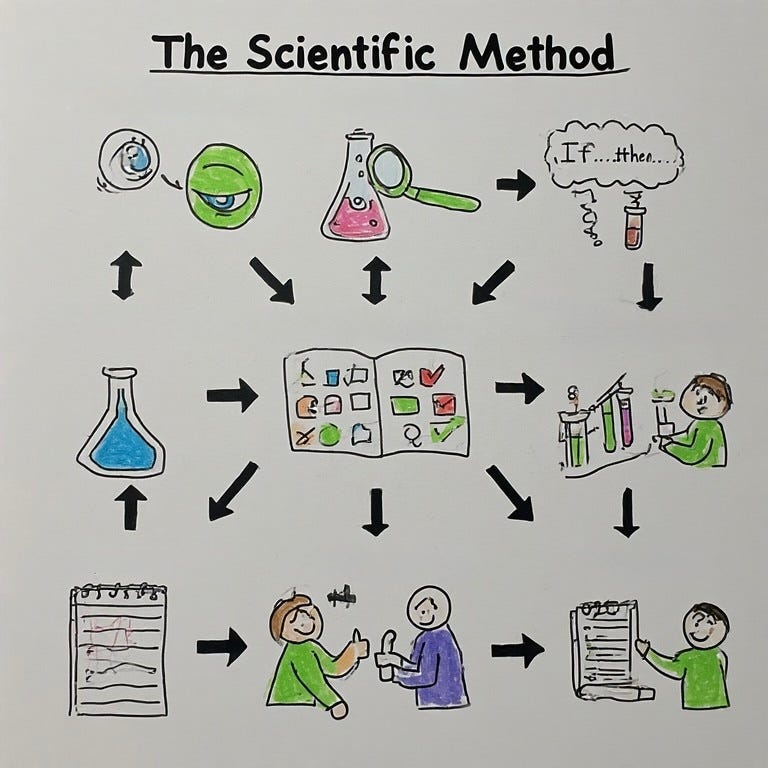
Modern science is widely regarded as the highest authority on truth. Its methods are invoked to resolve disputes, legitimize policy, and define what may be taken seriously as knowledge. Yet despite this authority, one of the most frequently used terms in scientific and philosophical discourse, objectivity, remains conspicuously undefined. It is referenced, approximated, debated, and defended, but rarely articulated as a distinct conceptual structure. This absence is not incidental. It reflects a deeper shift in how science understands its own success.
The scientific method does not create objectivity. It arises as a disciplined response to a more fundamental recognition: that reality exists independently of human preference and responds consistently to alignment. The method’s procedures—hypothesis testing, experimentation, replication, and revision—were designed not to generate truth autonomously, but to refine human models toward a reality that does not negotiate. Science works because it recognizes, even implicitly, that there is something external to us that constrains outcomes.
Objectivity, properly understood, is not a sentiment, a consensus, or a pragmatic success. It is a specific conceptual structure defined by identifiable conditions. An objective referent is singular rather than plural; incompatible truths cannot govern the same domain simultaneously. It is universal, applying across contexts rather than being locally negotiated. It is external, existing independently of observers. It is non-derived, not produced by human systems or conventions. It is independent, requiring neither belief nor enforcement to remain true. And it is invariant, remaining stable across time, perspective, and circumstance. Where these conditions are met, facts are possible at all.
These conditions are not abstractions removed from experience. They are why mathematical relations feel discovered rather than invented, why physical constants constrain engineers regardless of ideology, and why error remains meaningful. They are what make correction possible. Without them, disagreement collapses into preference and refinement into persuasion.
The scientific method functions as a recursive process that pressures human models toward this objective structure. A hypothesis proposes a tentative alignment. Experimentation confronts that proposal with externality. Replication tests invariance. Prediction probes independence from narrative or intent. Peer scrutiny reduces noise and individual distortion. Progress occurs primarily through elimination. What fails to align is removed. What remains does so not because it is persuasive, but because it survives repeated contact with reality.
This is why science converges. Convergence is not the product of consensus or authority. It occurs because reality is singular, external, and invariant. Competing models cannot indefinitely coexist when tested against the same referent. One will fail. The method succeeds because the structure it approaches is real.
However, operational success carries a hidden risk. As science began producing unprecedented predictive and technological power, attention shifted from what the method was refining toward to what the method itself could deliver. Over time, the assumption that objectivity exists independently—and that science merely approximates it—was left unexamined. The procedure remained intact, but the metaphysical humility that once grounded it eroded.
This shift marks the transition from refinement to dogma. When method is mistaken for ontology, science ceases to be a tool for alignment and becomes an authority in itself. Objectivity is no longer treated as an external structure to be approached, but as whatever current scientific models declare. Truth becomes provisional not as a matter of epistemic caution, but as a philosophical position. Consensus substitutes for universality. Predictive success substitutes for independence. Repeatability substitutes for invariance. What began as safeguards against error harden into justifications for enforcement.
Science’s success is not accidental. It depends on a prior recognition—often unspoken—that there is an objective reality and that this reality responds consistently to a specific structure. Experiments work because reality answers in the same way regardless of who asks the question. Predictions succeed because the underlying referent is singular and invariant. Error is possible because misalignment is real. None of this would be intelligible in a universe authored by preference, consensus, or narrative.
In the hard sciences, this recognition is tolerated because its implications remain largely mechanical. Gravity exerts authority without meaning. Physical constants constrain without judging. Submission to external reality is experienced as technical necessity rather than existential demand. The authority involved feels impersonal, and therefore unthreatening.
Outside these domains, the situation changes. If scientific methodology was strictly maintained in fields involving human behavior, values, or social organization, objective reality would not disappear. Instead, it asserts authority over interpretation. This is where resistance emerges. Not because the method fails, but because success becomes costly. Objective alignment introduces hierarchy between truth and error, coherence and incoherence, alignment and misalignment. The problem, now, is that truth becomes too honest. It demands correction rather than accommodation.
The resulting noise—competing frameworks, unstable definitions, moral overlays, and politicized uncertainty—is often mistaken for complexity. In reality, it functions as insulation. It preserves the appearance of scientific legitimacy while neutralizing the authority of objective reality itself. The language of science remains, but the structure it was meant to refine toward is obscured. The method is retained while its implications are systematically diluted.
This dilution explains why objectivity is constantly invoked yet never defined. To define it explicitly would require acknowledging externality and non-derivation—that truth is not authored by human systems. Such acknowledgment introduces an authority that cannot be revised, voted on, or subordinated to social priorities. In a cultural framework that equates authority with domination, this implication is resisted. Objectivity is therefore proceduralized, relativized, or treated as provisional by default. Science is permitted to use objectivity, but not to name it.
Yet recognition cannot remain indefinitely operational. Once objectivity is acknowledged as real rather than merely procedural, its properties raise an unavoidable question. The structure to which reality consistently responds is singular, universal, external, non-derived, independent, and invariant. Nothing within the universe satisfies these conditions. Everything that exists is contingent, variable, and dependent. Objective reality, therefore, cannot be grounded by the very domain it governs.
At this point, science encounters a boundary—not of reason, but of scope. The scientific method can refine models indefinitely, but it cannot account for the ground of the structure that makes refinement possible. Naming that ground is not a scientific act. But refusing to acknowledge it is not neutrality. It is a philosophical decision to leave the most consequential feature of reality undefined.
Recovering objectivity does not require abandoning science. It requires restoring the distinction between the method that refines and the structure that gives refinement meaning. Science regains its integrity when it is understood as a disciplined pursuit of alignment with an external, authoritative reality—one that precedes human inquiry and constrains it. When that distinction is lost, science does not become more cautious or humane. It becomes self-referential, measuring the ruler with itself.
Science works because objectivity exists. When science forgets this, it does not lose power—it loses grounding. Its authority expands as its reference point collapses. To recover the spirit that once animated scientific inquiry is not to retreat from reason, but to recognize the structure that reason itself depends upon.
Objectivity is not what science declares.
Science succeeds because objectivity remains when declaration is no longer enough.