


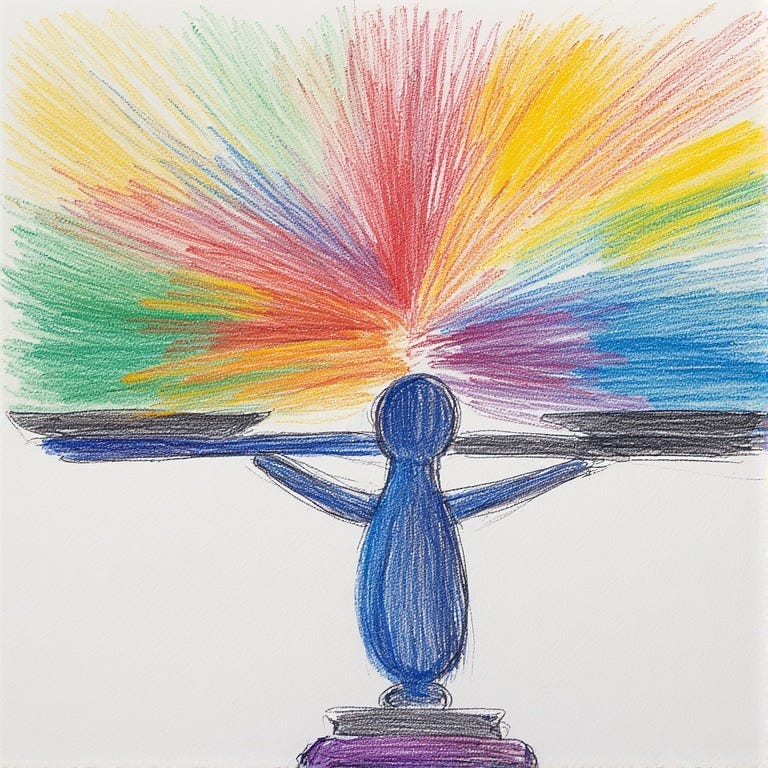
Impartiality is powerful. It allows the observer to see everything as it is; fully present, fully revealed, without distortion. The more practiced one is in building impartiality, the clearer things appear. Facts take their rightful shape, and the noise of preference quiets. Impartiality brings reality into focus; bias bends it. Where bias enhances and diminishes, exaggerating one feature while fading another, impartiality brings all things into full light. It shows what is, not what one wishes to see.
To be impartial is to meet reality on its own terms. It is the act of standing within the moment without twisting it through expectation, sentiment, or fear. In impartiality, clarity replaces conflict. It is not indifference, it is engagement without interference. It is the stillness that allows truth to surface from within the chaos of interpretation.
Yet impartiality is often mistaken for detachment. Detachment steps back and overlooks. It observes from afar and, in doing so, misses the fine texture of things. Impartiality, by contrast, draws everything closer, it places each element in proportion to its counterparts. It does not flatten difference; it illuminates it. Detachment leaves the picture incomplete; impartiality completes it by including every contour.
Impartiality is not the absence of care, it is care disciplined by truth. It demands the courage to see without leaning toward or away from what is seen. It is the capacity to let reality reveal itself, even when that revelation is uncomfortable. To practice impartiality is to align perception with coherence itself, to bring one’s vision into harmony with the structure of what exists.
The power of impartiality lies in its singularity. To see clearly, one must look from a single, stable point, an unbroken reference that is not part of what it observes. Without that singularity, there is only noise, shifting with every perspective. Impartiality depends on this one-pointedness: it allows every feature of reality to be seen in relation to the same constant on the same common denominator. That is how coherence is built. All sciences, all reasoning, all fair judgment rely on this principle. To measure anything, there must be one measure that does not move and applies to every component being measured.
But this singularity is not passive neutrality. It is active responsibility, a stance of reverence toward what is. Impartiality does not withdraw from the world; it stands outside in order to serve it more truthfully. It observes not to dominate but to understand, not to separate but to sustain. In this way, impartiality becomes the highest form of participation: it allows the observer to recognize and preserve the integrity of every element, maximizing the good for all that exists within the frame.
The authority of an objective reference over its subjects is not an act of control, it is an act of illumination. Its purpose is not to command, but to reveal. By showing things as they are, it allows every subject within the frame to navigate reality with greater precision and autonomy. It provides orientation, not oppression; direction, not domination. Just as a compass governs the traveler without ruling them, the objective constant governs understanding without imposing will. Its authority lies in coherence itself, it brings order simply by being unmoved.
Society often misunderstands this power. Through sentiment and propaganda, impartiality is made to appear cold or elitist, while bias is dressed as passion or morality. Yet the truth is the opposite. Impartiality protects fairness; bias protects agendas. Impartiality reveals coherence; propaganda obscures it. When people abandon the discipline of singular reference, when they trade impartial clarity for emotional alignment, they surrender their ability to see the system as a whole. The result is fragmentation, confusion, and control.
Impartiality, then, is not merely an ethical choice; it is the foundation of intelligence itself. It is the act of stepping outside the turbulence of opinion to see the entire system in proportion to one constant. It is the recognition that oneness, singularity, is what makes clarity possible. Only through it can truth be known, coherence maintained, and balance preserved. It is not a retreat from life, but a commitment to seeing life as it truly is, so that nothing—no fact, no person, no truth—is ever left behind.