


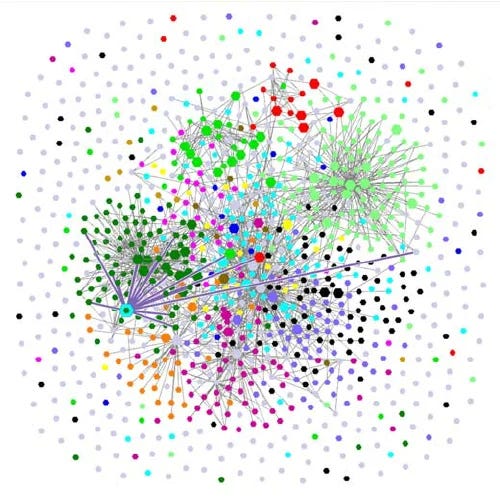
Things make sense before we know why. We experience this constantly. A child knows that a dropped object falls before knowing anything about physics. We know that a person remains the same person even when their clothes, location, age, and circumstances change. We recognize that different events are connected even when we cannot yet explain exactly how.
The explanation comes later. The coherence comes first.
This is important because we have developed a habit of confusing the explanation of a fact with the fact itself. We are often taught that unless we can explain something completely, we should suspend recognition of the thing itself.
But that is not how knowledge actually begins. We see something happening. We notice that it is consistent. We notice that different things are constrained in the same way. We recognize a pattern first. Only afterward do we begin asking why.
That basic ability, to recognize that something coheres before we know its ultimate explanation, is what is meant by factual awareness. We have become remarkably bad at noticing it.
Religion can interfere with it by filling the unknown with explanations. Secularism can interfere with it by refusing to recognize coherence unless the unknown has already been explained. They appear to be opposites, but they produce the same result, that the person stops looking at the fact.
To recover factual awareness, we need to understand the shape of coherence itself.
Coherence is not consensus
Start with the simplest possible graph.
        P
      / | \
     A  B  C
Something about P constrains A, B, and C. We do not necessarily know what P is, but we can observe the relationship between the nodes. A, B, and C are not merely agreeing with one another. They are cohering around something upstream.
This is the basic shape of coherence: one reference constraining many things that they form a level. Anytime you see a level, that means that coherence is potentially occurring.
Now compare that with consensus.
     A ↔ B
      ↕  ↕
     C ↔ D
Here the nodes can influence one another horizontally. They can discuss. Negotiate. Persuade. Vote. Compromise. Eventually they can reach an agreement. It can converge upon a single node and look like coherence. That agreement can be real and socially powerful, but it is still different from an independent constraint.
Consensus is something the participants produce. Coherence is something they encounter. We can agree that a particular rule should exist. We cannot agree that reality must obey us. We can create a convention. We cannot create the constraint that makes the convention work.
This gives us a simple distinction:
Consensus is created. Coherence is discovered.
And this is why coherence matters for facts. A fact is not simply something a group has agreed to call true. A fact constrains what can be true.
The real world does not look like a clean tree
Of course, reality does not usually look like this:
          P
       /  |  \
      A   B   C
Real life is messy. The image at the beginning of the essay is a real node graph. There are many-to-many relationships. There are feedback loops. There are overlapping contexts. There are competing systems. There are social agreements mixed with physical constraints. There are people influencing institutions while institutions influence people. There are beliefs influencing behavior while behavior reinforces beliefs.
A real graph might look more like this:
 A ───── B ───── C
 │ ╲     │     ╱ │
 │   ╲   │   ╱   │
 D ──── E ─────── F
  ╲     │ ╲      ╱
    ╲   │   ╲  ╱
      G ───── H
This is where coherence becomes difficult to see. The problem is not necessarily that there is no structure. The problem is noise.
We have to learn how to reduce the noise. We have to zoom in. We have to zoom out. We have to separate one context from another. We have to ask which connections are actually necessary and which are merely incidental. And, most importantly, we have to ask whether the apparent coherence is actually objective coherence or whether it is a social construct.
Zoom in
Suppose we begin with a messy graph:
 A ── B ── C
 │ ╲ │ ╱ │
 D ── E ── F
      │
      G
We can zoom in on a particular level.
Perhaps A, B, and C are all being constrained by E.
        E
      / | \
     A  B  C
That is a hypothesis about the local structure. We can then test it.
Does changing E affect A, B, and C? Does the same constraint apply across the set?Does the relationship remain stable across different circumstances? Are A, B, and C actually part of the same context? Or did we simply draw lines between things because they happened to occur together? Is this a matter of causation or correlation?
Zooming in helps us remove irrelevant relationships. It lets us examine the local structure.
Zoom out
But sometimes the opposite problem occurs. We zoom in so far that we mistake a local relationship for the whole system. Suppose we see:
        E
      / | \
     A  B  C  D
We might think E is the ultimate parent. But perhaps E itself is downstream:
        P
        │
        E
      / | \
     A  B  C  D
And perhaps P is itself downstream from something else:
        Q
        │ \
        P  .
        │   \
        E    .
      / | \   \
     A  B  C   D
The local explanation can be completely correct while still being incomplete. This is why we have to zoom both ways. Zoom in to separate noise. Zoom out to find the larger context.
A coherent level can have a parent several levels upstream. That parent does not have to be immediately visible.
A coherent level implies a parent upstream
This is one of the most important things to recognize. If A, B, and C genuinely cohere—not merely because they have agreed, but because they are independently constrained in the same way—then there is something upstream that accounts for that coherence.
        ?
      / | \
     A  B  C
The question mark represents an unknown parent. The point is not that we get to decide what is inside the question mark. The point is that the coherence itself gives us reason to look upstream.
If several nodes genuinely converge upon the same constraint, the constraint is not explained merely by saying that the nodes exist. The relationship needs a reference. This is why a coherent level always gives us another question:
What is upstream of this?
That question can continue.
        ?
        │
        P
        │
        Q
      / | \
     A  B  C
Q explains something about A, B, and C. P may explain Q. The unknown parent may explain P. The graph expands as we follow coherence upstream.
We should not invent the unknown nodes. But we should not pretend the question disappears simply because we cannot yet identify them.
The six conditions emerge from the graph
Once we begin following coherence upstream, we repeatedly encounter the same requirements. The objective reference in any given context is always singular, external, independent, invariant, universal, and ultimately non-derived. These are not six arbitrary characteristics. They describe what the reference has to be like if it is actually functioning as an objective constraint. They describe the conditions for something to actually constitute as a fact.
Singularity
Start with the basic graph:
        P
      / | \
     A  B  C
There is one reference. If there are two competing ultimate references:
       P       Q
      / \     / \
     A   B   C   D
then we do not have one unified context at that level. We have two. The justification for the coherence of set (A, B, C, D) has not been identified, and a resolution has not yet occurred. The constraint of that level implies that a parent that eventually explains both:
          R
        /   \
       P     Q
      / \   / \
     A  B  C   D
Now the apparent conflict has been resolved one level upstream.
This is what singularity means. A coherent context ultimately converges upon one reference. Zero distracts from recognition of the coherence. Multiple competing ultimate references means that justification remains unresolved.
Externality
The parent must actually be upstream.
        P
        │
        A
P cannot be A. It cannot be one of the children whose coherence it is supposed to explain.
Externality is therefore structural, not spatial. The parent is external because it is not merely another member of the set being grounded. It sits upstream because it holds dominance and the children are dependent, forming the observable constraint.
Independence
The parent must not depend upon the children.
        P
      / | \
     A  B  C
If A disappears, P does not cease to be P. If B disappears, P does not become something else. If C disappears, P does not lose its independence. The dependency runs downward.
P → A
P → B
P → C
rather than upward. This matters because an objective reference cannot be generated by the very things it is supposed to constrain.
Invariance
Invariance is especially important because it tells us something about what we can infer from coherence.
Suppose P constrains A, B, and C.
        P
      / | \
     A  B  C
Now imagine P changes. If P is actually the constraint responsible for the downstream structure, then changing P should have consequences downstream.
        P₁
      / | \
     A₁ B₁ C₁

        ↓

        P₂
      / | \
     A₂ B₂ C₂
The downstream constraint would be affected because the thing doing the constraining changed. That means that when we observe the downstream relationship remaining stable while circumstances change, we can infer something important, that there is a stable constant upstream of those changes.
The children may change. The observer may change. The location may change. The context may change. But if the relationship continues to hold, something upstream is remaining stable enough to preserve the constraint.
That is what invariance tells us. We do not directly observe the ultimate constant merely by naming it. We infer its stability from the stability of what it constrains.
If the parent changed arbitrarily, the downstream constraint would change with it. If the downstream constraint remains stable, then the reference responsible for it cannot simply be shifting with every downstream change.
This is why invariance is not merely “the parent stays the same.” It is a structural inference that stable coherence implies a stable constraint.
Universality
If the same parent is responsible for a coherent level, its constraint must apply across that level.
        P
      / | \
     A  B  C
If P constrains A and B but C is completely outside the constraint, then we need to investigate. Maybe C belongs to another context whose coherence is justified further upstream. Maybe P was misidentified and a parent upstream is the true dependency within the context of A, B and C. Maybe the model is incomplete.
The apparent exception tells us something. Universality does not mean every thing in existence behaves identically. It means that within the relevant context, the same objective constraint applies.
Non-derivation
Non-derivation is closely related to invariance. If we discover A is because of Q:
        P
        │
        Q
        │
        A
we can ask: Why Q?
Perhaps the answer is P. Then we ask: Why P?
Perhaps there is another parent.
A → Q → P → R → S → ...We can continue moving upstream.
But the entire point of moving upstream is eventually to reach a reference that is not itself derived from another reference. Otherwise we have not reached an explanation.
We have only moved the question. This is where invariance and non-derivation meet.
If the coherence we observe is stable, then its ultimate reference cannot itself be an endlessly shifting product of downstream conditions. And if every upstream reference is itself derived from something else, we never arrive at the stable basis that explains why the coherence at a level is stable in the first place.
The graph can contain many levels. But the explanation of objective coherence cannot terminate in an infinite chain of entirely derived nodes. Eventually, something has to be non-derived to justify the stability of the coherence we are observing downstream.
The unknown parent is not an excuse to stop thinking
At this point we have a useful position:
          ?
          │
          P
        / | \
       A  B  C
We know something about the lower level.
We know P appears to constrain A, B, and C. We may know that P itself appears to be constrained by something upstream. But we do not yet know what ultimately occupies the question mark.
That is okay. We do not have to invent it. But we also should not erase it. The disciplined position is:
I recognize the coherence. I recognize the direction of dependence. I do not yet know the complete upstream explanation.
That is factual awareness.
Where theology can distract from the fact
This is where theology is a problem. The problem is not the recognition that there is something objective upstream. That recognition is precisely what the graph gives us. The problem comes when the unknown parent is immediately filled with an elaborate explanation.
          P
        / | \
       A  B  C
becomes:
             ●
             |
        ● —- P —- ●
          /  |  \
         A   B   C

or

              ●
             / \
            ●   ●
           / \ / \
          ●   ●   ●
           \ / \ /
            ●   ●
           / \ / \
          ●   ●   ●
           \  |  /
              P
            / | \
           a  b  c
Now attention has moved. Instead of examining the actual coherence, people become concerned with defending the contents of the box. Every religion is a premature explanation of the assumed parent node that justifies an observable coherence. Every religion’s definition of God and gods is a premature explanation of what should simply be recognized as a generic node instead.
A structural observation has been turned into a complete story. The original fact may have been:
These things are cohering around something upstream.
The theological system may then add:
Therefore the unknown parent must have these specific characteristics, relationships, manifestations, symbols, attributes, stories, or internal structures.
Such a structure may or may not be true in certain cases. But they are additional claims that do not apply for every case, and should therefore not become the rule. They should not be confused with the actual observation of the pattern thatall factual claims possess.
A node is a node. The fact that it is a parent does not tell us everything inside it. This is how an explanation can distract from the fact it was supposed to explain.
Where secularism can distract from the fact
The opposite mistake is to refuse to recognize the unknown parent at all.
The reasoning becomes:
We cannot empirically identify the parent, therefore we should not recognize the coherence.
But this confuses two different questions.
Is the relationship observable?
and
Have we completely identified its ultimate source?
Those are not the same question.
If A, B, and C consistently cohere, the fact of that coherence does not disappear because P remains unidentified. Yet this is where, in this framework, atheism, agnosticism, and deism can become forms of apathy toward coherence recognition.
The criticism is not that every atheist, agnostic, or deist personally lacks curiosity or does not recognize facts. The criticism is structural.
If the intellectual framework says:
Do not concern yourself with an objective parent unless you can first empirically identify it,
then the framework has effectively trained the person to stop at the coherent level. It says that the parent node:
?is not worth examining.
The person is left with:
A B CThe coherence is still there. Its relationships are not arbitrary simply because the upstream reference has not been identified. What has been abandoned is the upstream question itself—and with it, public recognition of the coherence in question. This is what is meant by apathy toward coherence recognition.
The problem becomes especially apparent when we compare the hard sciences with the social sciences. In the hard sciences, coherent structures are generally permitted to be recognized even when the underlying nodes can be investigated and empirically identified. In the social sciences, however, structures whose nodes cannot be empirically isolated or identified are often treated as too indeterminate to recognize as coherent at all. But the inability to empirically identify a node does not make the relationships downstream from it arbitrary, nor does it invalidate the coherent structure those relationships form.
Unknown is not the same as nonexistent. Unidentified is not the same as incoherent.
The problem is not uncertainty. Uncertainty is healthy. The problem is treating uncertainty as a reason to stop recognizing the structure that produced the question.
Empiricism is good, but it is weaponized into a gatekeeper
Empiricism is valuable. We need methods for distinguishing observation from imagination. We need evidence. We need repeatability. We need to be careful about what we claim.
But empiricism becomes a problem when it is used not as a method for investigating facts, but as a gatekeeper that determines which facts the public is even permitted to recognize.
You can recognize:
P → {a,b,c}
as a coherent relationship while still saying:
“I don’t yet know what P ultimately is.”
Both secularism and theology hinder us from making this statement.
In theology, the theological gatekeeper says:
You may recognize the upstream reality, but only after accepting our explanation of what it is.
In secularism, the secular gatekeeper says:
You may recognize the downstream pattern depending on the category, but since you are not permitted to treat the unknown upstream reference as a legitimate object of inquiry until it has been empirically established, we will block the recognition of the downstream pattern in certain categories.
Both move the public away from the fact of the coherence itself. One says here is the explanation. The other says there is no reason to look there.
Neither teaches the person to sit with the actual structure. P → {a,b,c} gets attacked in one of two ways:
Attack on P: The existence of the coherent level is acknowledged, but recognition of P is made conditional on first accepting a particular explanation of what P is. The unknown parent is filled in, defined, or contested until attention shifts away from the fact that P → {a,b,c}.
Attack on the set: The upstream P is treated as illegitimate, unknowable, or outside the permitted category of inquiry. As a result, {a,b,c} is not allowed to be recognized as a coherent set organized by P. The downstream pattern is fragmented, reclassified, or treated as coincidence until P can be independently established.
So the two tactics can be stated very simply:
Attack P: “You cannot recognize P without first accepting an explanation of P.”
Attack the set: “You cannot recognize P → {a,b,c} until P has first been empirically established.”
The underlying point is that neither condition is logically required to recognize the level itself.
The firewall
Religion and secularism can both place a firewall upstream of the graph by supplying an authorized structure for what lies above the observable level. The objective undefined node is no longer left undefined. It is populated with a theology, mythology, hierarchy, or symbolic structure, leaving room for an upstream ontology to become installed while being blocked by the stand in structure from public recognition. The stand-in structure occupies the position of the unknown parent and can prevent people from examining the actual upstream question for themselves. This is how shadow governments can form.
Secularism can produce the same affect that religions do by making intersubjectivity the highest permissible parent. Instead of allowing the question to move upstream toward an unknown objective node that maintains the dynamism for the downstream graph, the structure terminates in the people themselves: by the people, for the people, according to what the people collectively recognize.
  A ────┐
  \     │
  B ────┼———————————-→ [P]
  /     │             / | \
  C ────┘            /  |  \
                    B₁  B₂  B₃
In this model, consensus becomes the parent node. And consensus is not the same as coherence. Consensus is like a crew in a ship without an anchor, left to drift while assuming that they know their coordinates.
That is not the same as saying that democratic agreement or social coordination is illegitimate. Intersubjectivity is real and useful. People can create rules, institutions, languages, norms, and agreements together. Civilization cannot exist without it. The problem begins when that intersubjective level is treated as though there is nothing meaningful upstream of it. It is as though the anchor does not matter.
If the population has not learned to recognize coherence in real time, then consensus can become the same firewall as religion. The population is permitted to organize the downstream network, but is discouraged from asking what independently constrains the people doing the organizing. The result is a structure that appears self-grounding:
the people → their consensus → their institutions → their norms → their decisions.
But the people themselves are still nodes in a larger reality. They did not create the constraints under which they exist, nor did they create the fact that their choices have consequences. An intersubjective parent can organize a downstream network, but it does not thereby become an objective parent.
This is why secularism, in this sense, can resemble a religion structurally. It can install a terminal reference—human beings and their collective agreement—while treating the upstream ontological question as either meaningless, unknowable, or outside the legitimate scope of public inquiry. The difference is not that one has a structure and the other does not. Both have a parent structure. The difference is what each permits the public to recognize as fact.
The danger is therefore not simply that people might believe the wrong explanation. Belief is subjective, it is a hypothesis and can be wrong. It is that an entire population can become unable to recognize the coherent structure that has real implications before the explanation is supplied.
The firewall works either way: one says, “Our explanation of the objective framework is what there is.” The other says, “You may organize yourselves, but you may not publicly recognize an upstream objective reference until it has been empirically established.”
In both cases, the public is diverted from the same basic recognition:
coherence can be recognized before its ultimate explanation is known.
That is why the central question is not which institution, religion, majority, or expert gets to occupy the parent node. The prior question is whether the parent node is being recognized as something independent of the network it organizes at all. Is there an anchor that can help us remain tethered to the greater reality we are operating within, or are we locked in an institutional bubble of circularity?
Reduce the noise
This is why learning to see coherence is more important than adopting another ideology.
Real life is full of noise. Look at a social system:
        A
      ↙ ↓ ↘
    B → C ← D
      ↘ ↑ ↙
        E
Some relationships may be causal. Some accidental. Some may be social conventions. Some may be feedback loops. Some may be temporary. Some may be created by human agreement. Some may be independent constraints.
The first job is not to declare what the graph means. The first job is to reduce the noise. Separate the contexts.
Context 1:

      P
    / | \
   A  B  C


Context 2:

      Q
    / | \
   D  E  F
Then zoom out.
           R
        /     \
       P       Q
     / | \   / | \
    A  B  C D  E  F
Now we can see something that was invisible inside the original mess. Two apparently separate contexts may converge upstream. That is what systems thinking is supposed to help us notice.
Not invented stories. Not conspiracies. Not elaborate speculation. Actual relationships.
Learn to distinguish coherence from social construction
This distinction is essential. Suppose everyone agrees to use a particular word.
       AGREEMENT
      /  |  |  \
     A ↔ B ↔ C ↔ D
That is intersubjective coherence. It is real because it has implications. It can organize society. But the agreement is generated by the participants.
Now suppose four independent observers encounter the same physical constraint:
            P
       /  |  |  \
      A   B  C   D
The observers did not create P by agreeing about it. They discovered the same constraint.
The graphs may look similar from a distance. Their source is different.
This is why we have to ask:
Is this level coherent because something independent of the participants is constraining it, or because the participants have constructed a shared agreement?
Neither answer is automatically bad. Social constructs are necessary. Language is useful. Institutions are useful. Rules are useful.
The danger comes when a social construct is mistaken for an objective constraint. Then consensus becomes indistinguishable from truth.
Why losing this distinction is dangerous
Once people lose the ability to distinguish coherence from consensus, they become vulnerable to authority. If everyone says something is true, the agreement begins to feel like evidence.
If an institution repeats something often enough, its position begins to look like an independent reference. If a religious authority supplies an explanation, the explanation begins to look like the fact itself. If a secular authority says something cannot be considered, the question itself begins to look illegitimate.
In each case, something downstream has been mistaken for something upstream. The person has stopped asking:
        ?
      / | \
     A  B  C
and has quietly started treating an invention as the parent. That is the structural error.
Faith is the way back
So how do we recover factual awareness? Not by choosing another ideology. By developing faith in coherence. Faith here means trust.
Not blind belief in an explanation. Not accepting a story because an authority tells us to.
Trust that coherence is real. Trust that when something genuinely constrains multiple things, that constraint is not arbitrary. That it is not mere coincidence. Trust that when a stable pattern persists through changing circumstances, there is a stable structure behind it. Trust that when we follow the graph upstream, we will continue to encounter structure rather than chaos. And trust that the same conditions will continue to appear.
Coherence always fully resolves in singularity, externality, independence, invariance, universality, and ultimately, non-derivation. That is the pattern every factual claim you encounter has. You can take any common fact and test it yourself.
Faith allows us to keep following the structure when the explanation is incomplete. Without faith, uncertainty becomes paralysis. With blind belief, uncertainty becomes an excuse for invention. Faith in coherence gives us a third option: keep discovering.
Build trust by following the pattern
This trust does not have to begin as an enormous metaphysical commitment. It can begin with ordinary experience. You notice that something remains stable. You notice that different things are constrained by it. You test it. You change the downstream conditions. The constraint remains.
You move to another context. The relationship remains. You ask what is upstream. You discover another level. You ask why that level is stable. You move upstream again.
Over and over, the same structural features appear.
                 ?
                 │
                 P
                 │
                 Q
              /  |  \
             A   B   C
The more carefully we follow coherence, the more we learn to trust its shape. That is what faith should mean. Not:
I already know what the unknown is.
But:
I trust that coherence is real enough to follow even before I know its complete explanation.
That is a radically different relationship with uncertainty. Faith becomes much easier to understand when we separate it from belief.
Consider something as ordinary as dropping a ball to describe faith. I let go of it, and it falls. You can do the same, and it falls for you too. I did not invent this relationship, and neither did you. It does not depend on either of us. It was true before either of us existed, remains true regardless of what either of us believes, and will continue to be true after we are gone.
I may not know why the ball falls, but I can recognize what is objectively happening between the both of us. I can confidently infer that the phenomenon is singular in its reference, external to both observers, independent of either observer, meaning that it does not derive from either observer. It is universal in its application, invariant across observers and circumstances within the relevant conditions. If I keep asking why, the chain of explanation will begin to regress, but it cannot regress forever. I can infer that there is a why that eventually fits these same conditions but is not itself derived from something prior, based on the stability that a ball continues to drop if let go. Whenever a claim meets these conditions, I know that it constitutes as a fact.
This is not limited to empirical observation. Empirical observation is one way we encounter a fact, but it is not what makes something a fact. The structure is what actually confirms that something is a fact because it directly points to the constraint. This structure expands the recognition of facts beyond empirical limitations. A social relationship can also have objective structure even when it is not a physical object that can be isolated and measured. A parent-child relationship, an obligation, events, or a rule can be socially constituted without being arbitrary. Once the relationship is in place, it constrains the people within it. We do not create the coherence of the relationship merely by describing it; we recognize and interpret a structure that already places constraints on what can coherently be said about it.
The mistake is to confuse non-physical with non-objective. Something does not cease to have structure simply because its structure is social rather than physical. Empirical observation can help us identify the nodes and relationships, but the underlying question is the same: does the relationship remain constrained by something independent of any one observer’s preference? If it does, then objectivity is not limited to the laboratory.
That is where faith begins to become intelligible. Faith is not the same thing as inventing an explanation for what I do not know. It is trust in what I have recognized as real, even when I have not exhausted its explanation.
The ball does not become real because I understand gravity. Likewise, children are born to parents whether or not I understand parenthood. My incomplete explanation does not make the phenomenon subjective. I recognize the reality first; explanation follows. Social reality should not be treated as inherently subjective merely because its structures are more difficult to isolate empirically.
This is also why faith and belief should not be treated as synonyms. Belief is a hypothesis about what may be true. Faith is trust in what has been recognized as true or real. A hypothesis can be wrong. An objective constraint is not a matter of preference. Learning to trust the pattern that makes something objectively coherent is not a matter of belief, it is a matter of faith.
The same reasoning can be extended beyond what we can immediately measure. The question is not whether we are allowed to investigate what lies beyond empirical observation. The question is whether the same six conditions that define objective structure, the structure that makes empirical knowledge possible in the first place, can be followed coherently wherever it leads. Modern discourse has not demonstrated that this is impossible; it has instead narrowed the scope of objective inquiry toward technological advancement while obscuring the same underlying pattern in human and social reality, limiting public recognition of it and, in turn, constraining genuine self-awareness. You have been culturally conditioned to treat coherence as unspeakable until its objective constraint is empirically proven, even when that constraint can already be recognized and inferred from the structure itself.
Things make sense before we know
We do not need to know everything before we can know something for certain. We do not need to identify the ultimate parent before recognizing that several things are cohering. We do not need a complete theology before recognizing an objective constraint. We do not need to deny the upstream question because we cannot yet answer it.
We need to learn how to see the fact. Reduce the noise. Zoom in. Zoom out. Levels point out that coherence may be occurring. Separate contexts. Separate social agreement from independent constraint. Follow the relationships upstream. Do not fill an unknown node with whatever explanation you prefer. Do not erase an unknown node simply because you cannot yet identify it. And when a level genuinely coheres, recognize what that coherence implies. It implies an objective reference. A reference that must be singular. External. Independent. Invariant. Universal. And ultimately non-derived. That is how you learn to recognize the elephant in the room before anyone affirms you. That is how you learn to have a backbone. That is how you protect yourself from herd mentality. That is how you protect yourself from delusions.
The point is not to memorize six philosophical words. The point is to develop enough trust in coherence that you begin to recognize them naturally. When something genuinely coheres, you should expect there to be something upstream. When the downstream constraint remains stable while circumstances change, you should expect a stable constant. When the reference itself is explained by another reference, you should follow the graph upstream again. And when you reach the end of what you can know, you do not have to choose between inventing an answer and abandoning the question.
You can leave the node—the why—undefined and terminated until more details emerge. You can keep the coherence as the fact because you know the why upstream is objective without having proof. The coherence suffices. You can keep looking. That is factual awareness. And that is what faith in coherence makes possible.
Things make sense before we know why.
The fact comes first. The explanation comes later. Our job is not to force reality into an explanation. Our job is to learn how to recognize the coherence that is already there.