

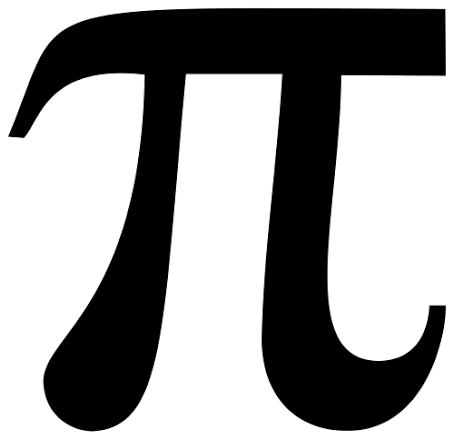
Imagine if someone told you that you needed to believe in pi.
You might ask what they mean. Do they want you to feel more certain that pi is real? Do they want you to identify with a community of people who accept pi? Should you repeat your belief in pi every day to strengthen your conviction? Should you defend your belief against people who reject it?
None of this is how we approach mathematics. We recognize pi as a constant relationship between a circle’s circumference and its diameter. We rely on it because it allows us to calculate that relationship consistently. We do not need to manufacture belief in pi. We need to understand it and apply it correctly.
We also do not get to use pi selectively when it matters. We cannot use one value when it suits us and another when it doesn’t. We cannot change the relationship because we disagree with the answer it produces. If we want our calculations to remain coherent with circular geometry, we must respect the constant that constrains them.
Pi does not become more reliable because we believe in it, and it does not become less reliable because we reject it. Our attitude changes. The relationship does not.
This distinction reveals something important about how we approach truth. We already know how to recognize objective principles, rely on them, and maintain them consistently. We do it in mathematics, engineering, and science every day. Yet when the conversation turns to ultimate reality, we often abandon this way of thinking and relocate the entire question into the category of belief, where belief quietly turns into a topic about opinion, not trust in how facts remain a constant phenomenon of reality independent of what exists.
Suddenly, the important questions become whether we believe, what we believe, why we believe, and which community shares our beliefs. The focus shifts from the reality we are trying to understand to the psychological and cultural positions we take toward it.
But what if this is the wrong starting point?
What if ultimate reality is not something we need to believe into existence—something we need to empirically verify in order to gain public legitimacy—but something we need to recognize as the objective ground against which our beliefs, judgments, and actions must be measured?
Consider what makes pi useful. We can invent symbols, develop formulas, and debate mathematical descriptions. But we do not create the relationship those descriptions are meant to represent simply by agreeing on them. The relationship constrains our calculations whether we recognize it or not. Our freedom to describe reality does not give us the freedom to make reality conform to every description we invent.
This is the difference between creating a representation and creating what the representation refers to. We can create maps, but we do not create the landscape merely by drawing it. We can develop measuring systems, but choosing a unit does not mean we invented every relationship we measure. We can disagree about a result, but disagreement does not settle whether the result is correct.
Reality remains the reference point that makes the distinction between a correct and an incorrect calculation possible.
This is what objectivity means at its most fundamental level. Objectivity is not the absence of perspective. We all have perspectives, and consciousness is perspective. Objectivity is the presence of a reality that does not depend on any one perspective to remain what it is. Our knowledge can change, our interpretations can be mistaken, and our understanding can improve. The objective reference against which we evaluate those things does not have to change with us.
Once we recognize this, we can ask a deeper question: if objective relationships constrain individual things within reality, what makes the coherence of the entire system possible?
Pi is a constant within a mathematical framework. It helps us understand circles, but it is not the ultimate ground of everything that exists. Ultimate reality raises a different question. What must be true of the ground of a contingent world—a system made up entirely of things that depend on conditions beyond themselves—for that world to remain coherent at all?
A necessary objective reference cannot simply be one more dependent item within the set it grounds. It cannot be a person, place, thing or idea. It cannot derive its authority from the very things whose existence and coherence depend on it. If it did, we would still need to explain the conditions that make that reference reliable. The question would remain unresolved.
The argument, then, is not merely that the universe contains constants. It is that the coherence we encounter points toward an objective ground that cannot be reduced to the changing, dependent things it constrains. Such a ground must be independent of the contingent set, not derived from something prior, and universally constraining rather than selectively applicable. It must remain the reference rather than become another competing perspective within the system. Without this, facts would not be a phenomenon of the system. But facts are a phenomenon of the system.
This exposes the problem with the modern belief culture that secularism quietly promotes. It promotes debate over an optional belief that is added to an otherwise self-explanatory world, and distracts attention away from the necessary reality that quietly grounds the world’s objective order, making truth, facts and science possible. The name should not end the inquiry. The task is to understand the pattern that all facts have in common and examine whether the structure of reality supports it.
This also changes how we understand the relationship between objectivity and success.
When an engineer respects the constraints of a material, the resulting structure is more likely to hold. When a scientist discovers a reliable relationship, that knowledge can make previously impossible technologies possible. When we understand the actual conditions of a human situation rather than acting on assumptions, we become better equipped to respond to it.
In each case, our actions become more effective when our understanding accounts for the reality that constrains them. We do not need reality to reward us intentionally. We need to stop working against the conditions that determine whether our efforts can succeed.
This does not mean that objectivity guarantees every desired outcome. We can understand a situation correctly and still face uncertainty, competing constraints, or circumstances beyond our control. But reliable action requires some degree of coherence with the conditions in which we act. Our intentions cannot replace that requirement.
The more accurately we recognize those conditions, the more effectively we can navigate them. Sometimes the resulting clarity, consistency, and capability exceed what we could have achieved through our own assumptions alone. We benefit from aligning our limited perspective with constraints that extend beyond it.
This is why an objective principle cannot be something we apply only when it agrees with us. If we accept a standard when it produces convenient answers and reject it when it challenges us, we are no longer using it as an objective reference. We are using our preferences as the reference and borrowing the language of objectivity when it suits us.
We would never consider that sound mathematical practice. Yet we routinely tolerate the same inconsistency in how we approach truth, morality, human nature, and ultimate reality. Each of us are participants in the same system that consistently remains singular, external, independent, not derived from anything prior, invariant, and unlike any of us. This constant universally constrains us while we remain ignorant of what it is. But we ask for objective results while allowing those underlying conditions to shift according to the observer, the context, or the preferred conclusion in different scenarios. We change the goalpost while relying on the same reality that objectively sustains facts for us in real time.
The answer is not to replace one belief system with another and demand stronger conviction. It is to learn how to recognize the difference between what we want to be true and what remains true regardless of what we want.
We do not make pi objective by believing in it. We recognize that its precise value expresses a constant relationship that constrains the measurement of every circle, regardless of who measures it, where it is measured, or whether the person measuring it even knows pi is real. It is singular in its reference, invariant in its value, independent of our recognition, external to our preferences, universally applicable to circles, and not derived from the individual circles it measures. These are not simply properties we assign to pi; they are conditions we recognize through the consistency of the relationship itself. Every circle reflects that same mathematical constant, making pi a sign of the pattern that defines objectivity itself, and how objectivity is built into the broader mathematical system. Its reliability tells us something important: the system is not operating according to individual perspectives or cultural preferences. There is a stable constant constraining the relationships within it. Pi is that constant with respect to circles. The question is whether we can recognize the same principle, the same pattern, at the level of reality as a whole: that the coherence of the contingent system points toward a necessary, objective constant at its foundation. We do not make reality coherent by agreeing that it is coherent. We investigate the coherence already constraining us and bring our reasoning into alignment with it.
And we should not have to abandon that approach simply because we happened to have reached the question of God.
Perhaps the deepest problem with belief culture is that it trains us to ask whether we accept a claim before asking what makes facts true. It makes our agreement the center of the discussion when the real question is how facts themselves constrain both agreement and disagreement.
We were born knowing nothing. We had to learn from a world that existed before our understanding of it, through faculties we did not create for ourselves and relationships we did not invent. Our knowledge grew as we learned to recognize patterns, constraints, and consequences that remained in place whether we understood them or not. Maturity requires more than accumulating beliefs. It requires becoming better at distinguishing our assumptions from the reality that tests them.
The goal, then, is not to believe harder. It is to prioritize objectivity as principle, not as a convenience.
In any given context, recognize the constant. Understand what it constrains. Apply it consistently. Allow reality to correct your perspective rather than asking your perspective to overrule reality.
We already know how to do this in mathematics. The challenge is to stop treating it as though it becomes impossible when we turn to existence itself. The question, then, is not simply about belief and believers. It is about trust. Do you trust that reality objectively constrains everything that exists, regardless of individual perspective, and that our ability to succeed depends on recognizing and aligning our decisions with that pattern? Or is truth merely a convenience to prioritize when it suits us and set aside when it holds us accountable?
Does pi objectively constrain every circle, or can we undermine its value whenever it becomes inconvenient and still expect precision in our calculations? Do we need to believe in pi, identify with those who accept it, and defend our allegiance to it? Do we alienate those that remain ignorant of pi and consider them inferior for the ignorance none of us can escape? Or do we recognize that it constrains every circle equally and trust that applying it consistently is necessary for accuracy? Is the enemy those that remain ignorant of pi, or those that intentionally promote confusion about awareness of pi in order to maintain an advantage over accuracy? Furthermore, do we need to empirically observe what is logically keeping pi a steady constant upstream in order to recognize that pi constrains any and all circles? Why do we demand empirical evidence of the objective constant of reality that makes all facts an observable phenomenon in order to trust that reality is ultimately objective and not subjective? Pi is evidence that reality is ultimately objective in relation to what exists. Science is evidence that reality is ultimately objective in relation to what exists. Pi is a sign of reality’s ultimacy, as all facts are. The evidence of objective reality is in the phenomenon of constants and facts. Empirical evidence of the universal constant upstream of what we can observe is not necessary, nor is it within the scope of empiricism since the position that is neutral to existence cannot be empirically determined because it would then not be neutral. The phenomenon of facts are what allow us to legitimately infer the stability of an objective constant without overreaching into unwarranted speculation.
The distinction is that we do not need to manufacture belief in an objective constant. And if we understand this principle in mathematics, we should be willing to examine whether the same principle applies to reality as a whole. We need to recognize its reliability, trust the relationship it expresses, and abide by it in order to maintain coherence in all topics, not just the topics that produce technology, but also the topics that require us to maintain accountability.
Belief and faith are not the same thing. Believers and the faithful are not the same thing. One is an identity group that wants to win at any cost, the other is those that do not know everything, but prioritize facts and trust how truth as a phenomenon works over their own ego, even if it holds them accountable.
Ask yourself, which on are you? Are you a blind believer that lets ego overrule, or are you among those that have faith that facts reliably work independently of what exists, even when you do not have all the facts?