


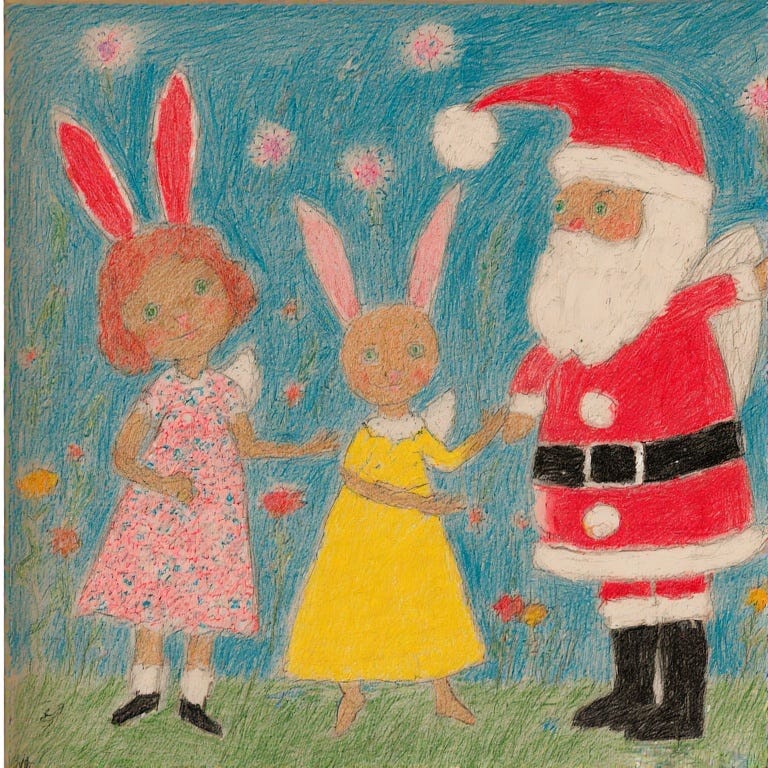
In the animated film Rise of the Guardians, mythical figures like Santa Claus, the Easter Bunny, and the Tooth Fairy unite to protect children’s belief. Their existence depends on it; if no one believes, they fade. It’s a beautiful metaphor. And yet, beneath the sparkle and snow lies something deeper, a cultural blueprint for how conviction is shaped and how reality is subtly displaced.
From early childhood, we’re taught that belief makes things real. Santa Claus comes only if you believe. The Tooth Fairy leaves money only if you trust the story. And when the magic eventually fades, it isn’t replaced by deeper clarity but by a quiet shrug that “It was just pretend.”
This wouldn’t be a problem if it were merely about play. But it often isn’t. It becomes a pattern about not just using imagination for exploration, but using belief as a replacement for recognition, an emotional tool to construct one’s own version of truth.
Imagination is one of the most powerful tools we possess. It allows us to create, envision, empathize, and aspire. It helps us explore what doesn’t yet exist and build what should. But when imagination is uncoupled from coherence, it becomes vulnerable; easily manipulated, hijacked by emotion, and turned inward rather than outward.
In other words, when we aren’t taught the difference between imagining and recognizing, we begin to treat reality as flexible, bendable to emotion, consensus, or personal need. That’s when make-believe becomes something else entirely, not creative, but delusional.
And this starts early. Children are often encouraged to believe in stories not as stories, but as realities, until they’re abruptly told otherwise. And rather than leading them from myth into a deeper, truer awe of the world, we often leave them suspended, with a subconscious lesson that truth is optional, and blind belief is what gives things power.
This training has long-term consequences. Adults raised on belief-as-truth begin to approach morality, justice, and identity through the same lens. If it feels right, if enough people agree, if it’s meaningful then it’s “real enough.” Objective standards become secondary to emotional resonance.
That’s why we live in a world where truths are treated as subjective, and facts are often subordinated to feelings. Where moral claims float without grounding, and where identity is affirmed or denied based not on coherence, but sentiment. If reality is just what we collectively believe, then those who shape belief shape the world.
This doesn’t just lead to confusion, it opens the door to exploitation. Unanchored imagination can be turned against itself. Stories once meant to inspire wonder become tools of control. Fantasy becomes marketing. Myths become dogma. Gaslighting works best on those taught that perception is everything.
But objectivity doesn’t kill imagination, it protects it. It creates the structure within which imagination can thrive without being hijacked. When we teach children to distinguish between recognition and invention, we empower them. We show them that some things exist regardless of what we feel, and that this isn’t limiting, it’s liberating.
Reality holds. The tree in the forest makes a sound even if no one hears it. The stars burn even when we sleep. And the most powerful truths are those that don’t require buy in to be true.
By grounding children in what is constant, we give them a foundation from which to imagine freely, safely, and creatively. They can still dream, but they won’t be deceived. They can still believe, but they’ll know when to recognize.
There’s something deeper beneath all this, and that is the understanding that we don’t make truth, we meet it. That reality is not something we construct emotionally, but something we align ourselves with intellectually and intuitively.
Recognition is humbling. It reminds us that we are part of something larger than our imagination. That the world is filled with wonder not because we believe in it, but because it was already there, waiting to be seen clearly.
When we teach this, we’re not taking magic away from children. We’re teaching them to guard it. We’re giving them the tools to preserve their sense of awe without being deceived by it.
We don’t need to abandon fairy tales. We need to clarify their role. Imagination should expand our minds, not replace our sense of what’s real. It should point us toward the beauty of what already exists, not away from it.
In a time where emotion is mistaken for truth, and perception is confused with reality, the ability to recognize what holds regardless of us is one of the most powerful forms of freedom.
Reality isn’t what disappears when we stop believing in it. It’s what remains when all memory fades, what sees clearly when the world forgets, and speaks for us when no one else will.
Excellent article.
While I appreciate Jordan Peterson’s defense of mythos and the archetypes expressed in cultural stories, your piece captures a deeper danger: when belief is mistaken for truth, and imagination is confused with recognition.
Those of us raised in religious traditions lived this confusion firsthand. We took the emotional resonance of stories as evidence of their truth. Surrounded by nodding adults and cloaked in reverence, these tales acquired an aura of legitimacy—despite contradicting the reality we encountered through direct perception. It took me more than a decade of philosophical and psychological unlearning to untangle that knot.
I came to see that without early conditioning, no rational mind would generate such ideas. Belief in supernatural volition—divine will summoning the universe into being ex nihilo—does not arise from observation. It must be taught.
That’s why I raised my daughter with an orientation toward reality rather than myth. When she first encountered religious claims around age nine—that the universe was willed into being, that seas part into walls, that manna falls from the sky, that virgins give birth and men rise from the dead—she laughed and said:
“Why am I reading these lies?”
This wasn’t rebellion or cynicism. It was recognition. She saw a contradiction between what was being claimed and what reality makes possible.
In response, someone like William Lane Craig might accuse her of assuming methodological naturalism. But she didn’t “assume” anything. What prevents a child from walking on unfrozen water isn’t a chosen philosophical framework—it’s the nature of water, the human body, and their inescapable relationship.
That’s objectivity. Not merely a method, but the recognition that reality has identity—that it is what it is, regardless of belief, tradition, or longing.
This is where your piece resonates most: it names what few are willing to admit—that teaching children to conflate belief with truth leaves them vulnerable not just to dogma, but to self-deception. It impairs the ability to distinguish recognition from invention. And it invites them, later in life, to elevate metaphor into metaphysics and mistake it for insight.
You see this in phrases like the “ground of being.” The words borrow from the world—“ground,” “being,” “foundation”—but drift free of concrete referents. What remains is often a profound psychological experience, dressed in ontological terms. But if the referent is internal, the experience belongs to psychology, not metaphysics.
This is not to diminish wonder, but to safeguard it. When imagination is tethered to reality, it becomes a tool for discovery. When it floats unmoored, it risks misleading more than it reveals.
Your article honors that distinction. Thank you for writing it.