

For a society that prides itself on freedom of belief, we sure do treat religion as something other people have.
We’re used to the idea that religion is a private choice—like picking a team, a favorite color, or a new diet. You either have one, or you don’t. Some people check a box, others don’t. End of story. But that story leaves out a critical truth: everyone has a religion, even if they don’t call it one.
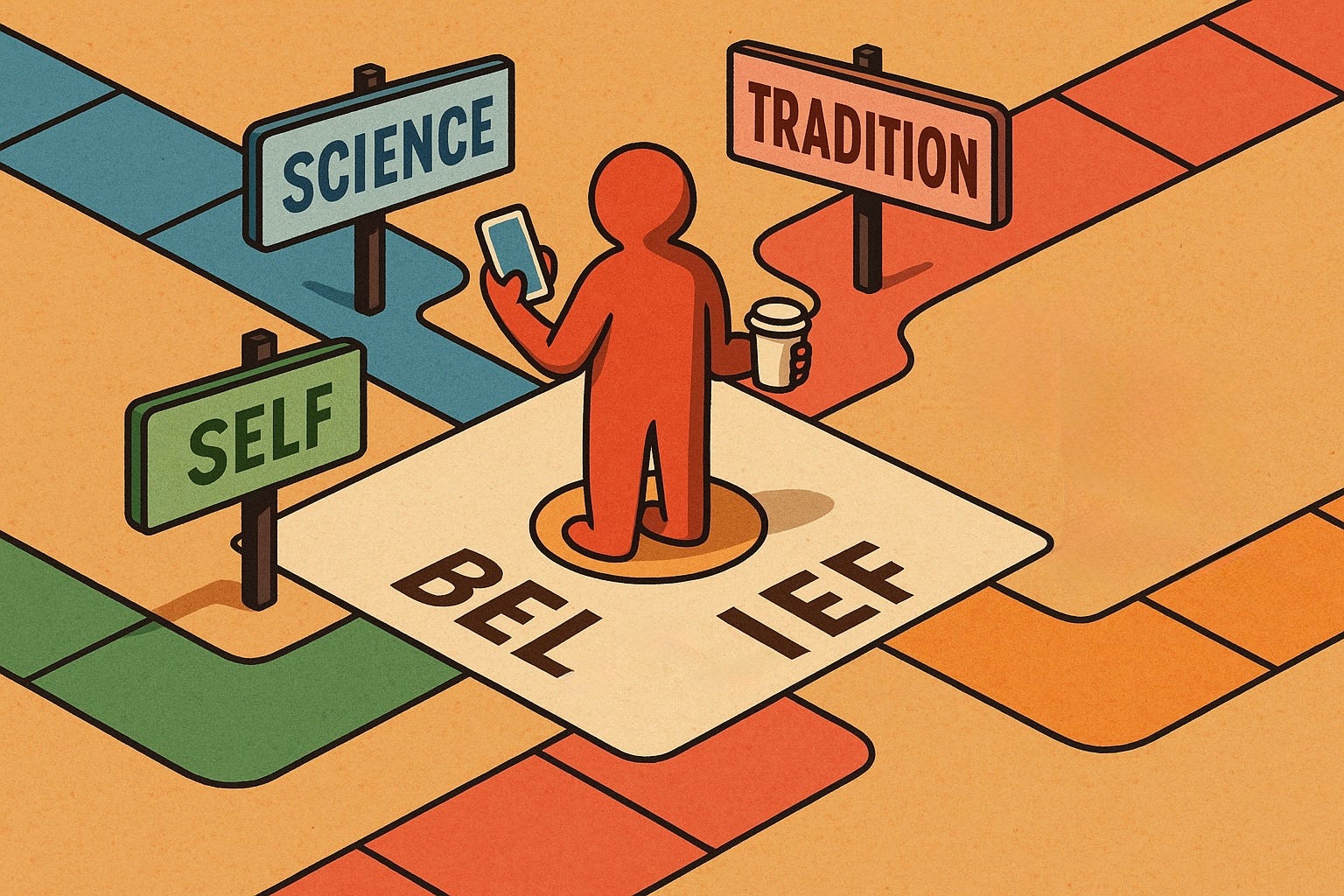
Not every religion looks like a temple or a prayer mat. Some people pray to the universe. Some follow the laws of economics or science as moral guides. Others trust their feelings as the final authority. The language might be different, but the structure is the same: we all live according to something we treat as sacred, ultimate, or unquestionable.
That’s what religion actually is—not a lifestyle club, but a person’s deepest trust in what is real, true, and worth living for.
This means the real divide isn’t between religious and nonreligious people, it’s between those who admit they’re religious and those who don’t realize it.
Take the person who says, “I’m not religious. I believe in science.” Sounds fair. But what is science, in that case? It becomes more than a method of investigation, it becomes an ultimate guide to life. It answers big questions: Where did we come from? What should we do? What matters most? That’s a religion, even if it wears a lab coat.
Or take the person who insists, “Everyone should choose what’s true for them.” That may sound tolerant, but it’s a moral position, one that assumes personal freedom is the highest good. That too is a kind of religion. It offers a sacred value (freedom), an invisible authority (the self), and a commandment (don’t question someone’s truth). Again, same structure, different branding.
So why does it matter?
Because when we pretend religion is optional, we stop asking whether what we believe is actually true. Instead, we treat beliefs like outfits, customized for comfort. But not all beliefs are created equal. Some align with the structure of reality. Others do not.
Here’s where the deeper problem lies: the illusion that religion is just one “choice” among many makes it harder to recognize when our unspoken beliefs start to fracture our lives.
We see this fracture when morality becomes performative, when what’s “right” is determined by what’s trending. We see it when truth becomes political, and facts only count if they flatter our tribe. We see it when people chase meaning in everything from tech startups to astrology, while quietly feeling more disconnected than ever.
The human need to believe hasn’t disappeared. It’s just scattered.
So no, religion isn’t going away. It’s just going underground, camouflaged as politics, therapy, spirituality, or science. And when we stop naming it, we stop examining it. That’s dangerous. Because if your religion is subconscious, it’s unaccountable. You’ll follow something without knowing why and you’ll resist being questioned, because it feels sacred.
That’s why we need to bring religion out of the shadows, not just to protect religious people, but to protect everyone. We need to be honest that belief is not an accessory, it’s a foundation. Every one of us is standing on a belief that grounds our existence. The only question is whether it’s solid.
You can call it philosophy, ethics, worldview, or spirituality. But at the end of the day, we’re all religious. We all serve something. And the more we pretend otherwise, the more likely we are to mistake comfort for truth.
The choice isn’t whether to believe.
It’s whether to believe in something that’s actually true.
I have always believed that every individual has a belief system !
Call it religion !!
A important article !
Thank you for sharing
You wrote:
“That’s what religion actually is—not a lifestyle club, but a person’s deepest trust in what is real, true, and worth living for.”
But this kind of reasoning trades on metaphor in a way that renders the term religion so expansive as to become meaningless. By framing religion as simply one’s “deepest trust in what is real and worth living for,” the definition becomes so broad that no one can escape being labeled religious. This is not a philosophically precise claim—it’s a rhetorical sleight of hand.
Merriam-Webster defines “religious” as follows:
1. A personal set or institutionalized system of religious attitudes, beliefs, and practices
2. a. (1) The service and worship of God or the supernatural
a. (2) Commitment or devotion to religious faith or observance
3. A cause, principle, or system of beliefs held to with ardor and faith
4. (Archaic) Scrupulous conformity; conscientiousness
Entries 3 and 4 are metaphorical extensions of the second. That is, because religious believers tend to hold their creeds with fervor and conscientious devotion, similar intensity in secular contexts—like a diet, a fitness regimen, or a political ideology—has been described as “religious.” But metaphor is not definition (see Ground of being). Rhetorical overlap is not conceptual identity.
To collapse philosophical commitment or existential seriousness into religion is to erase the very distinction between logos and mythos, between reason and revelation. It’s a category error that obscures more than it clarifies. Most crucially, it bypasses what religion historically and ontologically presupposes: belief in, and often worship of, a supernatural order.
This same conflation lies behind the tired phrase, “I don’t have enough faith to be an atheist,” which falsely equates all ideas with religious faith and accuses the atheist of rejecting “God” with as much blind trust as the theist uses to affirm Him.
But this is confused at best. The atheist is not clinging to a category—they are rejecting it as empty. “God,” lacking identity, definable attributes, or observable referents, is not an objective concept apart from ideation alone. Denying it requires no leap of faith—only the recognition that one cannot believe in what has no epistemic content.
Attempts to transmute secular rationality into a form of “religion”—as if atheists are just unconsciously religious—betray a kind of conceptual desperation common to theistic apologetics. It is not an attempt to clarify the distinction between faith and reason, but to obliterate it, dragging rationality down to the level of faith.