


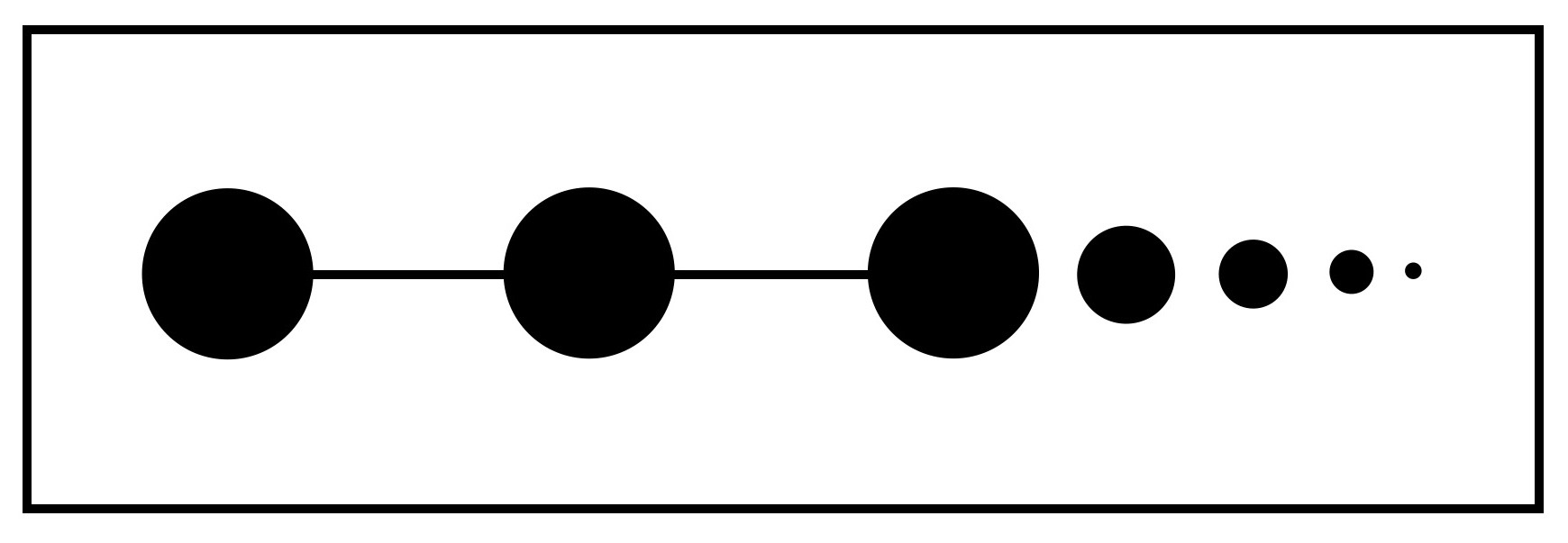
A child asks a deceptively simple question:“Why?”
You give an answer. “Why?”
You explain the answer. “Why?”
You explain the explanation. Eventually, you reach the point where you say, “Because that’s just how it is.”
The child may accept that answer. But nothing about the question itself has changed. The chain of justification has simply stopped because you decided that it was sufficient to stop. This is not a problem unique to children. It is a problem underneath every truth claim we make.
Every fact requires some reason why it is a fact rather than merely an assertion. But the reason can itself be questioned. If I say something is true because of X, I can ask why X establishes its truth. If you give me Y, I can ask why Y justifies X. Then Z. Then something before Z. The child has discovered infinite regress, and society has largely learned how to live with that regress without admitting that it exists.
We call something “fact” when the available justification is sufficient for the context. We call something “evidence” when the evidence is sufficient for the method being used. We call something “reasonable” when it is sufficient for the people evaluating it. And ironically, we often call something “objective” when the relevant community has agreed that the standard being used is sufficiently binding, as though consensus about a standard were the same thing as an objective standard. But what do we actually mean when we say something is objective?
Because sufficient is not the same thing as terminating. That difference matters far more than we usually admit.
A fact
Take a simple fact:
The test answer is wrong.
Why? Because the correct answer is 42.
Why is 42 the correct answer? Because the calculation produces 42.
Why does the calculation produce 42?Because these mathematical operations follow certain rules.
Why are those rules valid? Because they follow from a particular mathematical structure.
Why is that structure valid? Because it rests on certain axioms and definitions.
Why are those axioms and definitions justified?
Now we have moved beyond the original test question. The answer has not suddenly become false. The problem is that each justification introduces something that can itself become the subject of another “why?” This is what makes the question so powerful.
The child isn’t necessarily challenging the answer. The child is challenging the sufficiency of the justification. That distinction follows us everywhere.
Imagine that a glass broke because it fell. Why did it fall? Because it was pushed.
Why was it pushed? Because someone moved it.
Why did that person move? Because of another condition.
Why did that condition exist? Because of another condition.
And so on.
At every stage, we can provide a perfectly reasonable answer. But a reasonable answer is not automatically an ultimate answer.
We quietly choose where to stop
In ordinary life, we have to stop somewhere. No one can spend ten hours justifying why a glass fell before picking up the pieces.
The problem isn’t practical stopping. The problem is confusing practical stopping with ultimate justification. There are two common ways we decide that we have gone far enough. The first is personal:
“This is sufficiently justified for me.”
The second is collective:
“This is sufficiently justified for us.”
The first gives us personal certainty. The second gives us consensus. Neither necessarily gives us termination.
A person can be satisfied with an explanation and still be wrong. A society can overwhelmingly agree about something and still be wrong. Consensus can tell us what a group accepts. It cannot, by agreement alone, make the accepted proposition true. This is where modern society quietly relies on something it rarely names: crowd-sourced sufficiency.
We establish standards. Institutions establish procedures. Experts establish methodologies. Communities establish norms. Courts establish legal standards. Scientists establish accepted methods. Schools establish grading criteria. Employers establish hiring criteria. Governments establish legal definitions. And all of these can be useful, but usefulness is not the same thing as ultimate justification. At some point, every system has to answer the same question:
Why is this standard sufficient?
And if the answer is ultimately, “because this is the standard we accept,” then the justification has terminated in agreement, not in truth. That is a very different thing.
The problem becomes real when people’s lives depend on it
This is where the problem stops being philosophical and becomes dangerous. Consider a criminal sentence. A person is convicted because the evidence met the applicable legal standard. The court determines that the evidence was sufficient, the procedure was followed, and a sentence is imposed.
But now ask the child’s question: Why is this person guilty? Because the evidence established guilt.
Why is that evidence sufficient? Because it met the legal standard.
Why is the legal standard sufficient? Because the law establishes it.
Why is that law justified? Because the legislature enacted it.
Why is the legislature’s standard justified? Because it was established through the accepted political process.
Why is that process authoritative? Because the legal system recognizes it.
Eventually, somewhere upstream, we reach:
“Because this is the standard our society accepts.”
But that is not termination. It is only another stopping point. This is the crucial distinction:
Sufficient justification is only actually sufficient if the reason for its sufficiency has itself been justified.
Otherwise, “sufficient” simply means:
“This is where we have decided to stop asking why.”
That may be necessary for an institution to function, but it does not make the underlying conclusion objectively true. And this becomes extremely dangerous when the institution has the power to impose consequences on another human being.
A court is not merely expressing an opinion when it sentences someone. The state can take away their freedom. It can separate them from their family. It can restrict where they can live, what they can do, and how they can participate in society. In some jurisdictions, the state can even impose the death penalty.
So what happens if the justification underlying that sentence never actually terminates? The institution has converted a locally sufficient conclusion into a coercive fact. The court says: “This person is guilty.”But if the ultimate justification is only, “The evidence met the standard we have agreed to accept,” then the system has established that the conclusion is sufficient for the procedure, not that the procedure itself has reached an independently terminating justification. Without actual justification, justice is simply the mob in sheep’s clothing.
That distinction cannot be ignored once the system has the power to act on the conclusion. Because if sufficient justification is allowed to stand in for terminating justification, then opinion acquires the power of fact through institutional authority.
The danger is not simply that a judge might make a mistake. Human beings will always make mistakes. The deeper danger is structural:
What prevents the system from declaring a conclusion sufficiently justified when the underlying justification has never actually terminated?
If the answer is, “The law decides.” then ask why the law is sufficient.
If the answer is, “The legislature decided.” ask why the legislature’s standard is sufficient.
If the answer is, “The public accepts it.” ask why public acceptance makes it true.
If the answer is, “That is the accepted standard.” then the regress has not been solved. It has merely been buried beneath procedure. And once buried, the institution can exercise power as though the regress had been terminated. That is the pressure point that is worthy of sounding the alarm.
A society can create an extremely sophisticated procedure for deciding when it has enough justification while never establishing why “enough” is objectively enough. It can create courts, rules of evidence, appellate systems, expert testimony, standards of proof, juries, precedents, and procedural safeguards. All of these can improve reliability. But if the foundation remains merely collective sufficiency, then the entire structure can still be downstream from an unjustified stopping point.
The more powerful the institution, the more serious the problem becomes. Because the institution does not merely believe the conclusion. It can enforce the conclusion. It can take a person’s freedom based on it. And if the justification is ultimately only an accepted threshold, then the system has crossed a dangerous boundary:
It has turned consensus about sufficient justification into consequences imposed as though the underlying conclusion were independently established fact.
That is how opinion can acquire the force of reality. Not because opinion became truth, but because an institution acquired the power to act as though it were the truth.
This is why terminating justification cannot be treated as an abstract philosophical luxury. If a person is going to be sentenced, the question cannot ultimately be:
“Did we agree that the evidence was sufficient?”
The deeper question must be:
“What makes the evidence true independent of our agreement that the evidence is sufficient?”
Without that distinction, we have no ultimate barrier between justified fact and authorized opinion. And that is not a small gap. It is the gap between a system that discovers what is true and a system that possesses enough authority to declare what is true. The first is justification. The second is power. A society that cannot distinguish the two has not solved the problem of infinite regress. It has simply given the mob a uniform, a courtroom, and the power to impose consequences.
Evidence is not the same as justification
This is where empirical evidence is often asked to do more work than it can actually perform. Evidence is enormously valuable, but evidence answers a question within a framework.
If I drop a ball and observe that it falls, I have empirical evidence about what happened. If I repeat the experiment, I obtain stronger evidence. If thousands of people repeat it, we obtain even stronger evidence. But none of those observations answers the ultimate question:
Why should empirical observation itself be treated as an authoritative route to truth?
That is a different question. We can use empirical evidence to justify claims locally. We cannot use the existence of empirical evidence to automatically justify the epistemic authority of empiricism itself.
That would be like using the ruler to prove that the ruler is the ultimate standard of measurement. The ruler can measure things. It cannot, by itself, establish why the ruler should be the ultimate authority on everything that can possibly be true. Otherwise, that’s circular reasoning. If society permits circular reasoning as a sufficient justification, then it only requires power to leverage infinite regress to say that the mob’s justification is insufficient, because once consensus becomes its own justification, whoever controls the consensus—or possesses enough power to override it—can determine what counts as fact. And facts, therefore, become only illusion. But it doesn’t take a genius to know that facts are binding.
Let’s examine an example to help this concept come to life. Imagine a judge saying, “This person is guilty because the evidence meets our standard of proof.” That standard can tell us when the court is permitted to convict, but it cannot, by itself, establish why that standard is ultimately authoritative. If the ultimate answer to its authority is “because our system says so,” the justification becomes circular. And if consensus is allowed to justify itself, whoever has the power to challenge the standard in a particular circumstance can leverage that circularity to move the threshold of what counts as sufficient evidence. Yet, in practical terms, we may know that a person either committed the crime or did not. The fact cannot be recognized as true simply because enough people agreed to call it true. This is why the terminal justification needed cannot hinge on consensus: if the standard is justified by the agreement itself, then anyone with enough power to challenge that agreement can use the point at which we decided to stop asking why to reopen the question and move that ultimate authority. This is why consensus is not sufficient for terminal justification, even when we have empirical evidence.
This does not make empirical evidence useless. It makes it local. It is a method within a domain. The problem begins when a local method is elevated into the universal criterion for what can count as objective reality. Then the method becomes a gatekeeper, and the gatekeeper itself escapes the very standard it imposes.
Who decided what counts as an acceptable justification?
This is the question we rarely ask. Who decided that these forms of evidence are sufficient? Who decided which methods qualify? Who decided which questions are legitimate? Who decided which kinds of knowledge can count as objective?
Institutions did. Communities did. Academic disciplines did. Professional systems did. Historical processes did. People too distracted to bother did. These systems did not necessarily act maliciously. Many of their standards exist because they work extremely well for particular purposes.
But there is an enormous difference between saying, “This method is reliable within this domain.” and saying:
“This method determines the boundaries of objective knowledge itself.”
The first is methodological. The second is ontological. And the second requires justification. Otherwise, we have simply replaced one authority with another.
The public did not collectively sit down and prove from first principles which methods are capable of establishing objective reality. Most people inherit the standards already operating around them. They enter schools where certain methods are authoritative. They enter institutions where certain forms of evidence are admissible. They enter professional systems where certain criteria are treated as legitimate. And eventually those standards feel natural.
But familiarity is not justification. Institutional acceptance is not ultimate justification. Majority agreement is not ultimate justification. And social stability is not ultimate justification.
A standard can be useful, widespread, and deeply embedded in civilization while still leaving the question “Why is this ultimately authoritative?” unanswered.
Checks and balances do not terminate justification
At this point, someone might reasonably object, “Isn’t this why we have checks and balances?”
We don’t simply trust one person’s judgment. We have multiple judges, juries, appeals courts, legislatures, independent agencies, peer review, professional standards, opposing counsel, elections, and other mechanisms designed to challenge decisions and prevent abuse.
Yes. These mechanisms are valuable, but they solve a different problem. Checks and balances can constrain a justification without terminating it.
A second person can check the first person’s reasoning. A third institution can check the second. An appeals court can check the trial court. A legislature can check an agency. A constitutional court can check the legislature. The public can check elected officials. But then we can ask: Who checks the check? And after that: Who justifies the standard used by the final checker?
Eventually, the system has to stop somewhere. If every institution derives its authority from another institution, and every standard is justified by another accepted standard, then we have created an increasingly sophisticated network of mutual constraints without establishing an independent terminating reference.
We have made the circle larger. We have not made it non-circular. This distinction matters because reliability is not the same thing as ultimate justification. Checks and balances can make it less likely that a system will reach the wrong conclusion. They can expose errors, constrain corruption, distribute authority, and prevent one person from simply imposing their will.
Those are important functions. But none of them answers the deeper question: What makes the final standard objectively authoritative?
Suppose ten independent institutions review a decision and all agree that the justification is sufficient. That is stronger evidence of institutional agreement. But if the question is whether the standard itself is ultimately justified, ten institutions have not solved the problem that one institution could not solve. They have multiplied the agreement. They have not identified the independent reference that objectively constrains to make the decision true.
This is the difference between crowd-sourced sufficiency and terminating or ultimate justification. Crowd-sourced sufficiency says: “Enough independent people and institutions have agreed that we can stop asking.”
Terminating justification says: “We can stop asking because the justification itself no longer requires another justification.”
Those are fundamentally different. The first can produce a highly reliable system. The second produces an objective foundation. The first says that we can stop asking why because we collectively agreed to make this the stopping point. The second says the terminal justification has been identified, and it independently constrains us with or without our buy in. This distinction becomes especially important when the system is deciding something consequential about another human being.
A court may have a trial, a jury, an appeals process, and a supreme court review. That can make the legal system more resistant to error. But if every level ultimately relies upon a standard that is merely accepted by the system, then the entire chain remains downstream from a stopping point that has never been independently justified.
The safeguards can tell us that we have checked this conclusion from multiple directions. They cannot, by themselves, tell us that this conclusion is true because it coheres with an independent reference that stands outside our agreement.
That is why checks and balances are not a substitute for terminating justification. They are protections against the consequences of insufficient justification. They do not establish what makes justification sufficient in the first place. And this is precisely why an objective reference matters. Without one, we can build increasingly sophisticated systems for checking one another while remaining inside the same fundamental circle.
With one, those systems have something independent against which they can actually be measured. Checks can distribute authority. Evidence can increase confidence. Consensus can establish agreement. Procedure can establish sufficiency, but only a terminating reference can establish why the justification itself is ultimately sufficient.
Otherwise, we have not escaped infinite regress. We have simply built a better system for delaying facing the truth.
This is where the problem becomes dangerous
If no fact is ultimately justified, but simply agreed upon that we are ok with stopping here, then what prevents justification from becoming a contest of power?
Suppose two people disagree. Person A has evidence. Person B has different evidence. Person A says the evidence is sufficient. Person B says it isn’t. Who decides? A committee? A court? An institution? The majority? The expert? The person with the most credentials? The person with the most political power? The person with the most money?
At each level, we can establish a procedure for deciding. But then we can ask, “Why is that procedure authoritative?” If the answer is ultimately another human decision, the regress has not been terminated. We have only moved the decision upstream and hope that more and more people stop noticing in the process.
This is why power becomes so dangerous in a system without ultimate justification. Power can always attempt to substitute itself for justification.
The powerful person does not need to demonstrate that the claim is true if their power itself becomes the reason their claim is accepted. The institution does not need to demonstrate that its standard is objectively grounded if institutional authority becomes the justification for the standard. The majority does not need to demonstrate that its conclusion is true if majority agreement becomes the justification for truth. At that point, justification quietly becomes authorization, and authorization is not truth.
This is where nihilism becomes possible
Nihilism does not require someone to wake up one morning and declare that nothing matters. It can emerge much more quietly.
If every fact ultimately depends upon a stopping point chosen by an individual or collective, then nothing is ultimately secured from infinite regression.
Why is 1+1=2 true? Because we say so.
Why is that standard valid? Because we accept it.
Why should our acceptance matter? Because it is our consensus.
Why is consensus authoritative? Because we have collectively established it.
Why is collective authority valid? Because we agree that it is.
Eventually, the reasoning reduces to consensus, which becomes circular. We are not necessarily discovering a foundation. We are discovering the point at which the questioning community decided to stop. Without ultimate justification, the everyday facts we take for granted are only illusions.
That can be enough for administration. It can be enough for coordination. It can even be enough for civilization to function for a given amount of time. But it is not enough to establish facts as ultimately binding. And if no ultimate truth is possible, then “fact” becomes a practical designation rather than an ontologically secured one.
That is the danger. Not that we suddenly stop using facts. Rather, we continue using the word “fact” while quietly relying on standards that have never actually terminated the regress.
We need termination, not another explanation. The solution cannot simply be another fact. It is not sufficient to leave the line of reasoning open ended because that inconclusivity opens the door for corruption and a toy for power.
Consider the Big Bang. The Big Bang is an important scientific account of an early stage in the history of our observable universe, but it is a red herring when treated as though it can answer the question of terminal justification. It can describe what happened at an extraordinarily early stage of our universe, but it does not structurally terminate the regress of justification. We can still ask what preceded it, what explains its initial conditions, or why the underlying conditions were what they were. The point is not that the Big Bang is unimportant; it is that describing an event within the system is fundamentally different from identifying the structure that fully terminates the never ending question of “Why?”
Why was there a Big Bang? Perhaps because of a prior physical condition.
Why did that condition exist? Because of something prior.
Why did that exist? Something prior to that.
Even if we eventually identify the earliest physically describable state, we can still ask, “Why does that state exist at all?”
This is not an objection to cosmology. It is a distinction between two different questions. Cosmology can investigate what happened within the history of the universe. That is not asking what could terminate the regress that makes any fact about any topic at all capable of being justified at all.
The Big Bang is not designed to perform that function. Yet culturally, we often expect it to because modern discourse inappropriately frames it that way to us subconsciously.
A physical explanation remains an explanation within the physical domain. That is simply a chain of infinite regress. Instead, we are supposed to be looking for something capable of grounding the structure of explanation itself.
The terminating reference cannot be another contingent object
Imagine reality as a vast network of nodes. Every person, planet, particle, event, institution, idea, and physical state is a node within the network. Each node can have relationships to other nodes. Some things depend upon other things. Some things explain other things. Some things cause other things. Some things describe other things.
Now choose any node and ask, “Why is this the case?” You can trace its dependencies backward. But if every answer is another contingent node, then you have never terminated the regress. You have only moved upstream. The final reference therefore cannot simply be another contingent object inside the same network. It has to be structurally different.
And notice what kind of question this actually is. This is not fundamentally an empirical question. It is a computing question. Infinite regress can be represented computationally as a rogue while loop: a process that continues because nothing within the structure provides a condition that guarantees a full stop. The question is not whether or not one can find the loop physically in nature. The question is what structure can terminate a rogue loop in a generic fashion, at a genuine full stop, while leaving the internal dynamics of the loop free to operate.
That distinction is critical. We do not want to terminate the dynamic block inside the loop. The block must remain capable of receiving new information, changing states, producing different outputs, and allowing reality to remain dynamic.
We want to terminate the regress itself so that a sufficiently established chain of reasoning can be fully justified, without undermining the evidence by suggesting that its ultimate validity rests merely on our judgment, the very same judgement that should never become infallible. That means the termination condition cannot be something the block can modify, reinterpret, bypass, or regenerate. Every door through which the regress could escape has to be closed. But the closure cannot prevent the block itself from remaining dynamic.
We therefore need complete closure of the regress while maintaining complete openness of downstream discovery. The termination must be absolute. The contents must remain dynamic.
This is precisely what the six conditions that define objectivity ontologically accomplish. They are not six characteristics added after the fact. They are six structural locks on the ways termination could fail. Each condition prevents a specific failure at the top while also protecting the coherence and stability of everything downstream.
1. Singularity closes competing ultimate references and protects downstream coherence
Suppose there are two ultimate references.
At first this might appear harmless. We could simply have two independent foundations. But the moment they disagree, the system has a problem. Reference A establishes one truth. Reference B establishes another.
Which one takes precedence? If A takes precedence over B, then A is more fundamental than B. If B takes precedence over A, then B is more fundamental than A. If neither takes precedence, then we have two incompatible ultimate standards. Either way, the problem returns.
The two references cannot both be universally authoritative if they cannot reach coherence between themselves. They effectively establish two competing “verses” of ultimate justification, and there is no higher reference available to reconcile them.
That means coherence must exist at the top, not merely consensus downstream. If we permit two competing ultimates and simply agree to live with both, we have not solved the problem. We have institutionalized the contradiction. And the instability does not remain at the top.
Everything downstream inherits the conflict. If two ultimate references can produce different valid standards, then every dependent claim can potentially change depending upon which reference is being followed.
A foundation that permits its own fundamental contradiction cannot provide stable downstream truth.
Singularity therefore does more than prevent competition. It prevents the foundation itself from splitting into incompatible sources of coherence. There can be one ultimate reference only because there cannot be two independently ultimate references without reopening the question of what reconciles them. Neither than there be zero ultimate references, because the absence defaults ultimacy to the next in line. Singularity alone grants the stability necessary for terminal justification to remain constant.
The purpose is not uniformity. The purpose is terminal coherence. We require justification for the coherence we are unable to produce ourselves.
2. Externality closes the containment door and protects the global constant from downstream alteration
Suppose the terminating reference is another node inside the system. Then it belongs to the same dependency structure whose regress we are trying to terminate.
We can ask: What justifies that node? Whatever answers that question becomes more fundamental. The regress continues.
But there is another problem. If the supposed foundation is contained within the system, then the system can potentially affect the foundation. That makes the foundation downstream from something else.
And once the foundation can be changed by the system it is supposed to ground, every dependent structure becomes vulnerable to change.
Think of a global constant in a program. If the constant changes halfway through an operation because one of the processes inside the program modified it, the program will produce a different outcomes from its previous outcomes, deeming the outcomes incoherent. That is the fundamental definition of a defect. The problem is not merely that the constant changed. The problem is that everything downstream that relied upon the constant may now produce a different result. The foundation has become mutable from within the operation it was supposed to govern.
Externality prevents this. The terminating reference must be conceptually outside the dependency structure it grounds. Not spatially outside the universe, but ontologically outside the set of contingent things whose coherence depends upon it.
The system cannot reach backward and rewrite its own foundation. The global constant remains fixed while the operation remains dynamic.
3. Independence closes the dependency door and protects the foundation from being authored by its own outputs
Suppose the reference depends upon the things it is supposed to justify. Then its validity is downstream from the system. If the system changes, the reference changes. If human beings disappear, the reference disappears. If a culture rejects it, the reference loses its authority. If the universe changes, the standard changes with it. But a foundation that changes because of the things downstream from it cannot ultimately ground those things.
The direction of justification has reversed. Instead of:
foundation → system
we have:
system → foundation.
The loop has become self-referential. Independence closes that route. The reference must remain what it is regardless of whether the contingent entities within the set exist, disappear, agree, disagree, or change. This protects the foundation from being authored by its own downstream consequences.
A global constant cannot be determined by the operation whose behavior depends upon that constant. Otherwise, the system can eventually modify the very condition by which its own outputs are evaluated. Again, the regress returns.
4. Universality closes the fragmentation door and prevents multiple downstream foundations
Suppose the reference terminates one domain but not another. It explains physics but not mathematics. It grounds mathematics but not morality. It applies to the present but not the past. It works for one kind of truth but not another. Then we need another ultimate reference for the remaining domain.
We have recreated the problem of multiple ultimates, which contradicts condition 1 regarding singularity. Universality therefore prevents the foundation from fragmenting. The terminating reference must be capable of applying to any context.
This does not mean that it dictates the content of every context. It means that the same underlying criterion can receive every context without requiring a new ultimate criterion each time. Mathematics can remain mathematics. Physics can remain physics. Ethics can remain ethics. History can remain history. Future discoveries can remain genuinely unknown.
The contexts remain dynamic because the universal reference does not prescribe their contents. It provides the condition under which they can all remain objectively coherent.
Universality therefore protects both genericism and dynamism. The structure is generic enough to accept any context while remaining stable enough to prevent each new context from generating another foundation.
5. Invariance closes the temporal and contextual escape doors and protects downstream stability
Suppose the terminating reference can change according to time, place, culture, preference, perspective, or circumstance. Then we can immediately ask: Why did it change? What determined the change? Why is the new standard authoritative? Why should everything downstream now conform to a different foundation?
The regress has reopened. But again, the problem is not confined to the top. If the global constant changes during operation, everything downstream that depends upon it becomes unstable. The same input could produce different conclusions depending upon when the operation occurs. A truth could become true and then cease to be true because the standard itself moved. A right could exist under one foundational condition and disappear under another. A mathematical or logical relationship could become dependent upon context rather than remaining invariant.
The entire downstream structure becomes subject to foundational drift. That is precisely what invariance prevents. The reference must remain stable across time, location, perspective, preference, and circumstance. The contents of reality can change. Our knowledge can change. Scientific models can change. Human circumstances can change.
But the condition against which those changes are evaluated cannot itself shift every time the system shifts. The foundation remains invariant precisely so that everything downstream can be dynamic without becoming incoherent.
6. Non-derivation closes the final upstream door and provides the actual full stop
Finally, suppose the reference itself is derived from something prior. Then whatever it derives from is more fundamental. We simply move one step backward:
Why does the terminating reference have this property? Because something prior generated it.
Why does that prior thing exist? Because of something before it. And the regress continues.
Non-derivation closes the final upstream door. The terminating reference cannot be produced, generated, caused, or derived from something more fundamental. There is nowhere further upstream to go. This is the condition that gives us the actual full stop.
Without it, the other five conditions can describe an extremely stable reference, but they cannot prevent the question:
Why does this reference possess its authority rather than something prior to it?
Non-derivation answers that structurally. There is nothing prior from which the reference derives. The regress therefore cannot continue upstream.
The six conditions work together
This is why the six conditions cannot simply be treated as six unrelated attributes. They form a termination structure that suffices our need for justification rather than leaving that necessity open ended for power and corruption to manipulate.
Singularity prevents competing ultimate references from producing incompatible foundations and destabilizing everything downstream.
Externality prevents the reference from becoming another node inside the system and prevents the system from modifying its own foundation.
Independence prevents the foundation from deriving its authority from the very entities it is supposed to ground.
Universality prevents the foundation from fragmenting into domain-specific ultimates.
Invariance prevents time and context from changing the foundation and thereby changing everything downstream.
Non-derivation prevents anything more fundamental from existing upstream.
Together, they close the available routes by which infinite regression could reoccur. This is why they are conditions of terminal justification, rather than merely characteristics of something we happen to call objective. The structure can be understood as:
contingent claim → justification → further justification → further justification → … → terminating reference
The important point is that the final reference does not merely happen to be where we stop. There is nowhere left for the regress to go. That is the difference between a stopping point and a terminating point. A stopping point says, “We have decided not to ask another question.” A terminating point says:
“Another question of the same kind cannot move the justification further upstream because the conditions for further regression have been closed.”
And that is why the six conditions must be satisfied together. Remove singularity, and competing ultimates can reopen the question and destabilize coherence. Remove externality, and the system can contain and potentially alter its own foundation. Remove independence, and the foundation becomes dependent upon what it grounds. Remove universality, and separate domains require separate foundations. Remove invariance, and the foundation can change, forcing downstream structures to change with it. Remove non-derivation, and something prior can always be invoked.
Any open door is enough for the regress to return. And if we as a society rest on sufficient justification without terminal justification, then “facts” are merely cultural illusion.
The block can remain dynamic
The remarkable part is that terminal justification does not require freezing reality.
The dynamic block can continue operating. New data can enter. New relationships can emerge. New discoveries can occur. Existing models can be corrected. The future can remain genuinely unknown.
The six conditions do not dictate the downstream contents. They prevent the downstream contents from rewriting the conditions of objectivity.
In computing terms, the system can remain dynamic while the termination condition remains immutable. The operation can process changing information without being able to alter the condition that prevents infinite regression. In real life terms, it means that terminal justification does not impose upon free will. Instead, it protects free will from devolving into insanity by having a check on incoherence. It protects reason from becoming unreasonable.
That is precisely what we need: complete closure of the regress with complete openness of downstream discovery. A foundation that can be changed by the system cannot ultimately ground the system. A foundation that dictates every downstream state destroys the system’s dynamism.
The terminating reference must therefore be fixed at the level of structure while allowing flexibility at the level of content. Fixed foundation. Dynamic reality. That is the combination we are looking for.
This is why empiricism is not the test of the question
At this point, someone may ask, “But can you empirically find this terminating reference?” That question misunderstands what is being investigated. We are not looking for another physical object. We are identifying the necessary structure of termination.
Empirical investigation operates within contexts. This inquiry concerns the condition that allows any context to possess an objectively terminating justification.
Demanding that the terminating structure itself be empirically observable is therefore like demanding that the number zero be physically located before allowing zero to function as a legitimate mathematical reference.
We do not point to zero sitting somewhere in physical reality. We establish what zero means within a formal structure and then examine what follows from that structure.
The same principle applies here. The question is:
What must be true of a reference if it is genuinely capable of terminating infinite regress while leaving reality downstream dynamically open?
The answer is not another temporal object. It is a structure satisfying the six conditions. And the consequences of that structure can then be evaluated downstream.
This is the process we refer to whenever we refer to the word truth. The thing is, our minds do it so quickly that it is difficult to clearly articulate the process. If the structure fails to close one of the escape routes, the regress remains possible. If it closes all six, then we have identified the necessary architecture for terminal justification.
That is why the inquiry cannot simply be dismissed as “unempirical.” It is asking a prior question:
What would an actually terminating justification have to look like?
Before we search reality for anything, we have to know what we are searching for. And if the answer is a physical object inside the regress, we have already failed. The terminator must be capable of stopping the regress without becoming another link in it. That is exactly what the six conditions are designed to accomplish.
This does not restrict discovery
A genuine terminating structure should not eliminate uncertainty. It should make uncertainty intelligible. New scientific discoveries can occur. New mathematical relationships can be discovered. New historical evidence can emerge. New physical conditions can be identified. Our models can change. Our measurements can improve. Our understanding can deepen.
None of that threatens a genuine terminating reference. Why? Because the reference does not compete with the discoveries. It is what allows them to remain discoveries about something independent of us.
The map can change without changing the territory. Our explanation can change without changing the condition that makes explanation possible. That is what it means for the foundation to be upstream.
Why upstream stability matters
Every system has dependencies. If something upstream changes, everything downstream that depends upon it may have to be reconsidered. That is why foundational errors are so destructive. A wrong premise can still produce a perfectly coherent downstream system. The system can be internally consistent and still be wrong. Longterm, the foundation fails to sufficiently support the coherent structure it is suspending.
The problem is not necessarily in the calculation. The problem is that the calculation inherited an unjustified foundation. A terminating justification solves this differently. Once the foundational reference is stable, downstream claims can be evaluated relative to it. We don’t need to reinvent the standard every time a new fact appears.
The same structure can receive mathematics, science, morality, history, law, personal claims, and future discoveries without becoming any one of those things. That is what makes it a global constant rather than a local explanation.
Return to the test
Now let’s return to the child. The child asks, “Why is my answer wrong?”
You say, “Because the correct answer is 42.”
The child asks, “Why is 42 correct?”
You can continue answering forever. Or you can simply say, “Because that’s the answer.” But neither has actually adequately solved the problem. The answer is not ultimately wrong because the teacher says it is wrong. It is not ultimately right because everyone in the classroom agrees that it is right. It is right because it coheres with the independent structure that the question is testing. Reality is ultimately singular, external, independent, invariant, non-derivative, and universally applicable to everything that exists. And what reality ultimately is, will always remain unknown to us. That terminal position objectively constrains us, while providing the justification necessary whenever a fact is challenged. And it constrains us without constraining the dynamic nature of what exists. Reality can continue to remain dynamic. The justification is not created by our agreement; it is recognized because the conclusion coheres with what independently constrains it. Justification has been met.
With that recognition, the teacher’s authority can identify the answer. The class can agree on the answer. The textbook can record the answer. The empirical calculation can support the answer. But none of those things creates the truth of the answer. They are downstream from it.
This is the distinction between power and justification. Authority can declare. Consensus can agree. Evidence can demonstrate within a framework. But justification must ultimately explain why the claim is true independent of the people making the claim.
And now the stakes become clear
If we cannot make that distinction, then we have a serious problem. No one has acknowledged the elephant in the room. The right to exist becomes whatever society has agreed to protect. The right to speak becomes whatever society has agreed to permit.
The person who gets the job is the person who satisfies either the popularity contest or the prom king and queen’s taste. The person who gets into the school is the person who satisfies either the popularity contest or the prom king and queen’s taste. The person who makes the team is the person who satisfies either the popularity contest or the prom king and queen’s taste. The person who is rejected is simply the person who is not part of the status quo.
And all of these decisions can actually be reasonable. They can actually be carefully administered. They can actually be supported by evidence. They can even actually be overwhelmingly agreed upon. But if there is no objective justification upstream, no conscious recognition of what terminates infinite regression, then none of these standards is ultimately protected from being replaced by another standard.
A different institution can establish different criteria. A different majority can establish different rights. A different government can establish different laws. A different culture can establish different norms. A more powerful person can attempt to establish a different standard altogether. And if our only answer is another consensus, then we have not escaped the problem. We have simply created a larger crowd.
That is not enough. Because a right that is only a consensus is not an ultimate right. A fact that is only a consensus is not an ultimate fact. A standard that is only accepted is not an ultimate standard. And a justification that can always be replaced by another justification has not actually terminated the regress.
So why?
The child’s question is not the problem. The child’s question exposes the problem. Every “why?” forces us to confront the justification underneath the previous answer. Every justification can become another proposition requiring justification. Eventually, we either stop because we are satisfied, stop because society is satisfied, or find a reason why and how the regress genuinely terminates.
The first is personal sufficiency. The second is consensus. The third is objective justification. Only the third actually solves the problem.
The answer cannot be another contingent fact. It cannot be another empirical observation. It cannot be another institution. It cannot be another majority. It cannot be another authority. It must be a reference that remains stable regardless of who is observing, what is being observed, or when and where the observation occurs.
The answer is that it must be singular, external, independent, universally applicable, invariant, and non-deriving, and it has to remain unknown. Those conditions are not an arbitrary description of a preferred object. They are the structural requirements for something to actually terminate infinite regress with a full stop. That terminating reference does not need to dictate every downstream fact. It simply needs to be remembered while downstream reality remains dynamic. It does not tell us what every discovery will be. It tells us what makes a discovery capable of being objectively true.
It does not replace science. It explains why science can discover something rather than merely produce another consensus. It does not replace evidence. It explains why evidence can correspond to something independent of the observer. It does not replace reason. It provides the condition under which reason can be answerable to something beyond itself. And it does not replace truth. It explains why truth can be something more than whatever we have collectively agreed to stop questioning at the time.
So the next time a child asks, “Why?” don’t give them another stopping point. Ask what makes the answer actually terminate. Because if the chain never terminates, we have not found justification. And without justification, we are not stating facts. We have only found the place where the crowd stopped asking. And that is not the same thing as truth.